Strait of Hormuz – Tanker War
Strait of Hormuz
Assessing the threat to oil flows through the Strait
Tanker War
The anti-shipping campaigns during the Iran-Iraq War (1980-1988) are known as the Tanker War[i]. In 1981, Iraq began attacks on ships to weaken Iran’s ability to fight, initially attacking ships carrying military supplies to the groundwar front and later attacking ships carrying Iran’s exports. Iran retaliated by attacking ships belonging to Iraq’s trading partners and to countries that loaned Iraq money to support its war effort.
The first phase of the Tanker war began in May 1981, when Iraq declared that all ships going to or from Iranian ports in the northern zone of the Gulf were subject to attack. Iraq used its air power to enforce its threats, primarily Super Frelon helicopters, F-1 Mirage and MiG-23 fighters armed with Exocet anti-ship cruise missiles[ii]. Between 1981 and 1983, Iranian forces generally held their fire at sea.
But in 1984 Iraq escalated its effort, marking the second phase of the Tanker War. The arrival of French Super-Etendard combat aircraft, also armed with Exocet missiles, offered the Iraqis more range[iii]. Iran finally retaliated. Because Iran did not have many effective anti-ship cruise missiles during 1984-1986, it was forced to use creative tactics when targeting ships. For example, Iran used air-to-surface missiles intended to attack armored land vehicles, including Mavericks and AS 12s ” much smaller targets than even relatively small ships. Anti-armor missiles are designed to penetrate thick plating on tanks, an irrelevant ability for attacks on ships. Iran’s attacks caused little physical damage to ships, but successful hits on ships’ accommodation areas sometimes killed or wounded crew, interrupting transits.
RESOURCES
The Tanker War and the U.S.
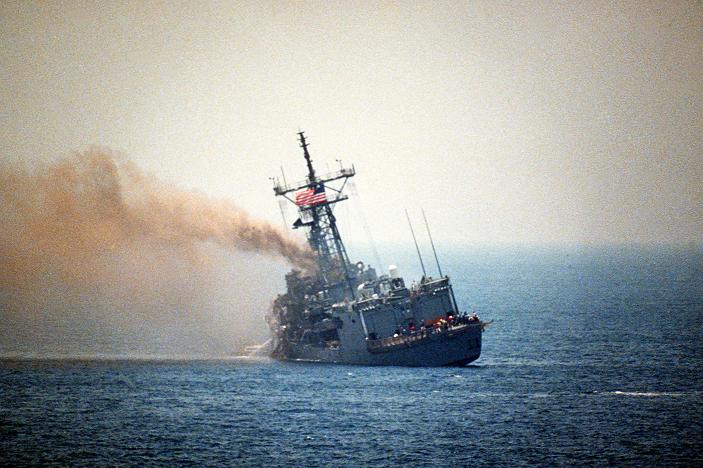
Image of the U.S.S. Stark after being struck by 2 Exocet missiles
Later in the Tanker War, Iran’s missile arsenal expanded to include relatively ineffective Sea Killer anti-ship cruise missiles.[iv] In 1987, Iran deployed Chinese CSSC-2 “˜Silkworm’ missiles with much larger warheads, Iran’s first effective anti-ship cruise missiles.[v]
In response to the increased effectiveness of Iranian attacks in 1987, Kuwait drew the United States into the region to protect oil tanker traffic. The U.S. reflagged Kuwaiti tankers, making them U.S. ships eligible for U.S. Navy escort, and provided security of shipping to and from neutral Gulf countries.[vi]
A Partial Chronology of the Events[vii]:
- October 7, 1980: Iraq declares that Gulf Water along the Iranian coast north of 29.03N a prohibited war zone.
- May 30, 1982: Atlas I, a Turkish oil tanker, becomes the first tanker to be hit during the war. While loading oil at Kharg Island, it is damaged by Iraqi bombs.
- December 18, 1982: Greek tanker, Scapmount hit by an Iraqi Exocet, becomes the first tanker to become CTL in the Tanker War.
- January, 1984: Iraqis escalate their naval war effort and Iran responds by beginning their naval war effort.
- February 14, 1985: Neptunia, a Liberian tanker, hit in the engine room by an Iraqi Exocet. The tanker sinks three days later due to an explosion, the first tanker to sink in the Tanker War.
- November 1, 1986: Neutral Kuwait appeals to the international community to protect its shipping interests in the Gulf, resulting in the “re-flagging” of Kuwaiti tankers. The USSR is the first nation to respond, and the US leads the international effort in order to minimize the Soviet role in the Gulf.
- March 7, 1987: The United States announces its decision to re-flag Kuwaiti tankers.
- August 8, 1988: Iran and Iraq agree to a cease-fire.
Lessons Learned:
The Tanker War provides a useful historical background on a hypothetical future conflict in the Strait of Hormuz. Below are some key takeaways from the eight-year conflict:
- Iran and Iraq used anti-ship cruise missiles in more than half of all attacks on shipping during the Tanker War. Iraq used missiles in approximately 80 percent of their attacks on commercial ships.[viii]
- Oil tankers are not very vulnerable to damage. 61 percent of the ships attacked during the Tanker War were oil tankers. In total, only 55 of the 239 petroleum tankers (23 percent) were completely sunk or declared CTL, compared to 39 percent of bulk carriers and 34 percent of freighters.[ix]
- The oil market is likely to adapt to disruption in the Strait of Hormuz. Initially, the Tanker War led to a 25 percent drop in commercial shipping and a sharp rise in the price of crude oil. But the Tanker War did not significantly disrupt oil shipments. In fact, Iran lowered the price of oil to offset higher insurance premiums on shipments, and the real global oil price steadily declined during the 1980s. Even at the its most intense point, the Tanker War failed to disrupt more than two percent of ships passing through the Persian Gulf.[x]
- Iran has little incentive to close the Strait of Hormuz. Despite repeated Iranian threats to close the Strait of Hormuz during the Tanker War, Iran did not follow through with this threat, as they themselves depended on the sea-lanes for vital oil exports.[xi]
[i] Martin S. Navias and E.R. Hooton, Tanker Wars: The Assault on Merchant Shipping During the Iran-Iraq Conflict, 1980-1988 (London: I.B. Tauris Publishers, 1996), p. 1.
[ii] GlobalSecurity.org, Iran-Iraq War (1980-1988). Online. Available: http://www.globalsecurity.org/military/world/war/iran-iraq.htm. Accessed: December 5, 2007.
[iii]”The Guns of ’88: Lessons of the Forgotten Tanker War,” American Thinker. Online. Available: http://www.americanthinker.com/2006/04/the_guns_of_88_lessons_of_the.html. Accessed: December 5, 2007.
[iv] Martin S. Navias and E.R. Hooton, Tanker Wars: The Assault on Merchant Shipping During the Iran-Iraq Conflict, 1980-1988 (London: I.B. Tauris Publishers, 1996), pp. 108, 114.
[v] Martin S. Navias and E.R. Hooton, Tanker Wars: The Assault on Merchant Shipping During the Iran-Iraq Conflict, 1980-1988 (London: I.B. Tauris Publishers, 1996), p. 153.
[vi] Anthony Cordesman, Iran’s Military Forces in Transition (Westport, Connecticut: Praeger, 1999). [vii] Martin S. Navias and E.R. Hooton, Tanker Wars: The Assault on Merchant Shipping During the Iran-Iraq Conflict, 1980-1988 (London: I.B. Tauris Publishers, 1996).
[viii] Wayne P. Hughes USN (Ret.), Fleet Tactics and Coastal Combat (Annapolis: Naval Institute Press, 2000).
[ix] Martin S. Navias and E.R. Hooton, Tanker Wars: The Assault on Merchant Shipping During the Iran-Iraq Conflict, 1980-1988 (London: I.B. Tauris Publishers, 1996), p. 183.
[x] Dennis Blair and Kenneth Lieberthal, “Smooth Sailing: The World’s Shipping Lanes Are Safe,” Foreign Affairs, vol. 86, no. 3 (May-June 2007), p. 7.
[xi] GlobalSecurity.org, Iran-Iraq War (1980-1988). Online. Available: http://www.globalsecurity.org/military/world/war/iran-iraq.htm. Accessed: December 5, 2007.