The Strauss Center at The University of Texas at Austin partnered with the Atlantic Council’s Cyber Statecraft Initiative to host another regional round of the Atlantic Council’s renowned cybersecurity policy competition, the Cyber 9/12 Strategy Challenge.
This stand-alone event took place at the University of Texas School of Law on January 27-28, 2024, with teams vying for a title that included, not just bragging rights, but also a cash prize for the top three teams (not to mention a deeply-enriching learning experience for all participants). Included in the two-day event will be opportunities for professional development from cybersecurity experts in the public and private sector.
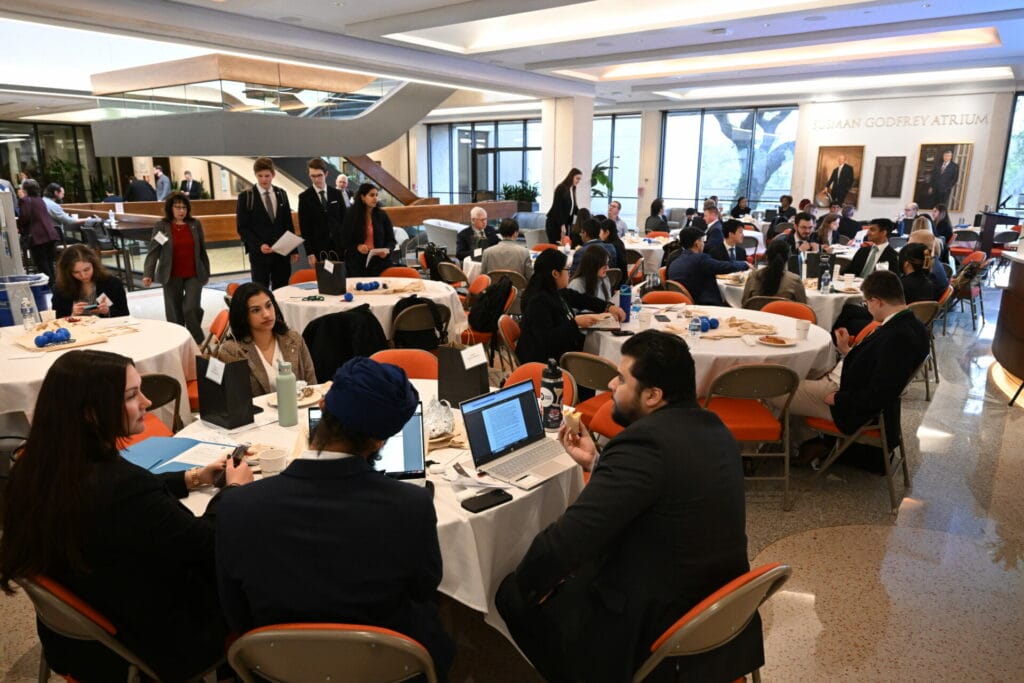
The weekend began with Robert Chesney, Dean of the University of Texas at Austin School of Law and Strauss Center cybersecurity program lead, giving welcoming remarks.

Next, Emma Schroeder Associate Director of the Cyber Statecraft Initiative at the Atlantic Council, walked student teams, judges, and coaches through the weekend’s agenda.

A qualifying round with 23 teams took place on the first day of the competition, followed by a fireside chat between keynote speaker Aaron Cooper, Deputy Legal Advisor to the National Security Council, and Adam Klein, Director of the Strauss Center. Student teams were able to ask questions about the National Security Council, privacy law, and how local and global issues challenge legal and governmental processes in America.

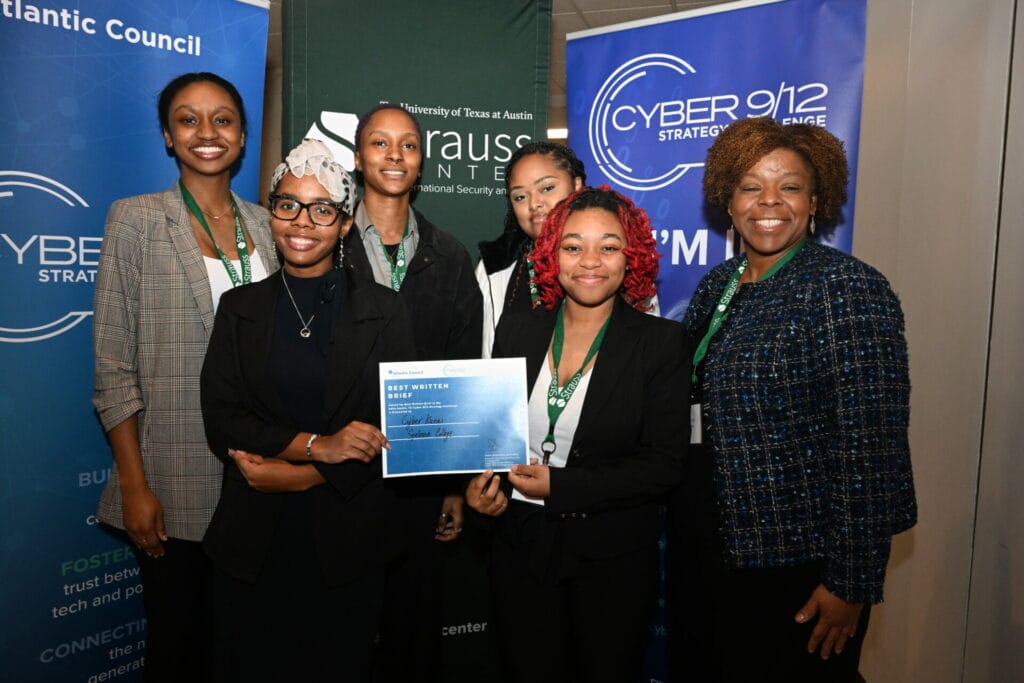
Awards and a pretzel reception followed the keynote, where semi-finalist teams were announced and awards were given to teams who uniquely tackled the cybersecurity strategy challenge presented at Cyber 9/12. The awards from this first day are below. The quality of written briefs, which teams produce prior to the competition, were so high that three teams were awarded “Best Written Brief”, in an unprecedented announcement.
Cyber Kunai of Spelman College were awarded “Best Written Brief”.
Alt+F4rce of the Air Command and Staff College were also awarded “Best Written Brief”.
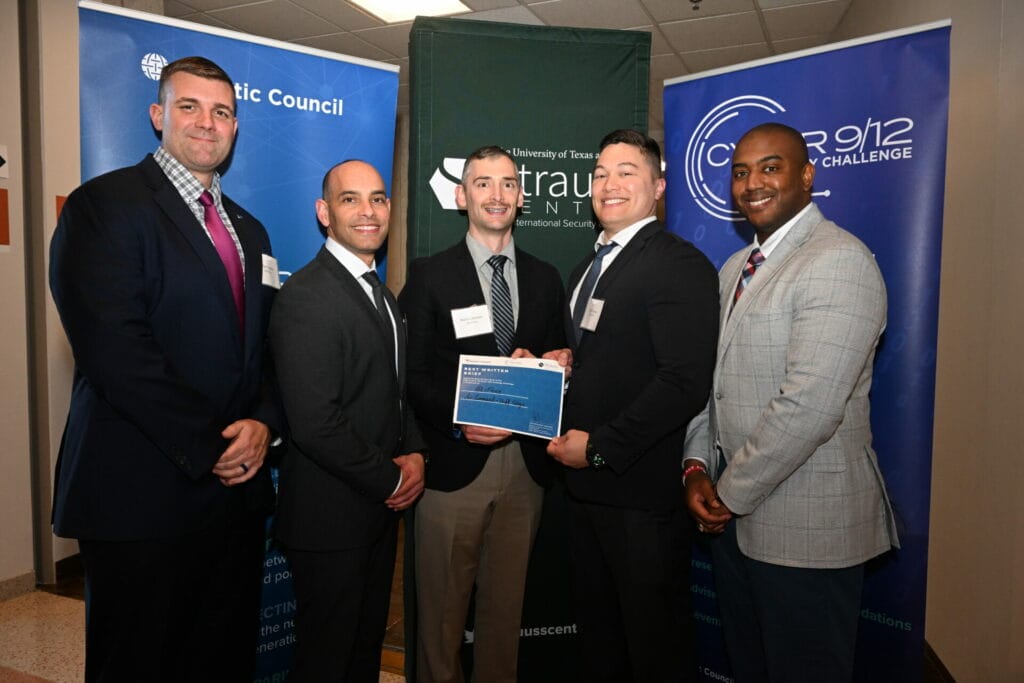
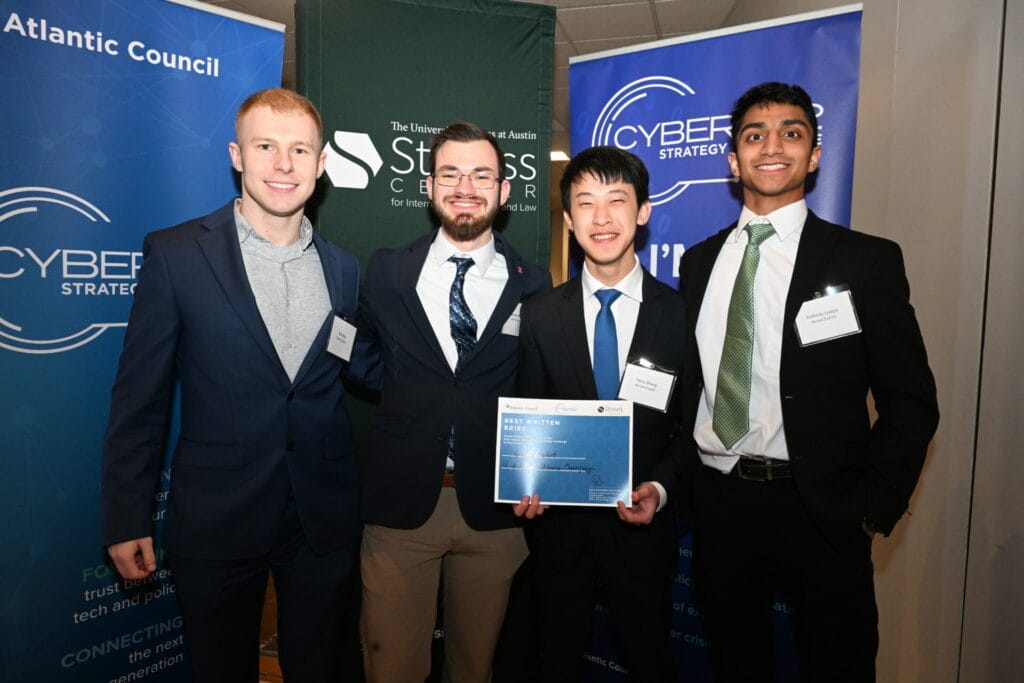
Kernel Exploit of the University of Indiana Urbana-Champaign were also awarded “Best Written Brief”.
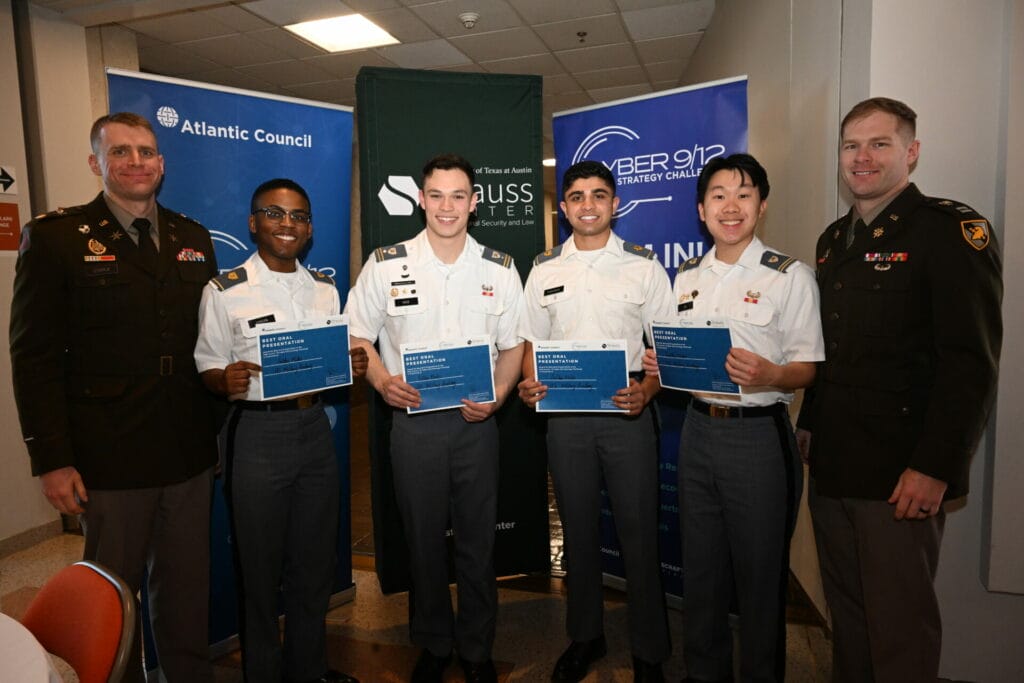
The Golden Mules of the U.S. Military Academy at West Point were awarded “Best Oral Presentation”.
D.A.T.A. of Duke University were awarded “Best Decision Document”.

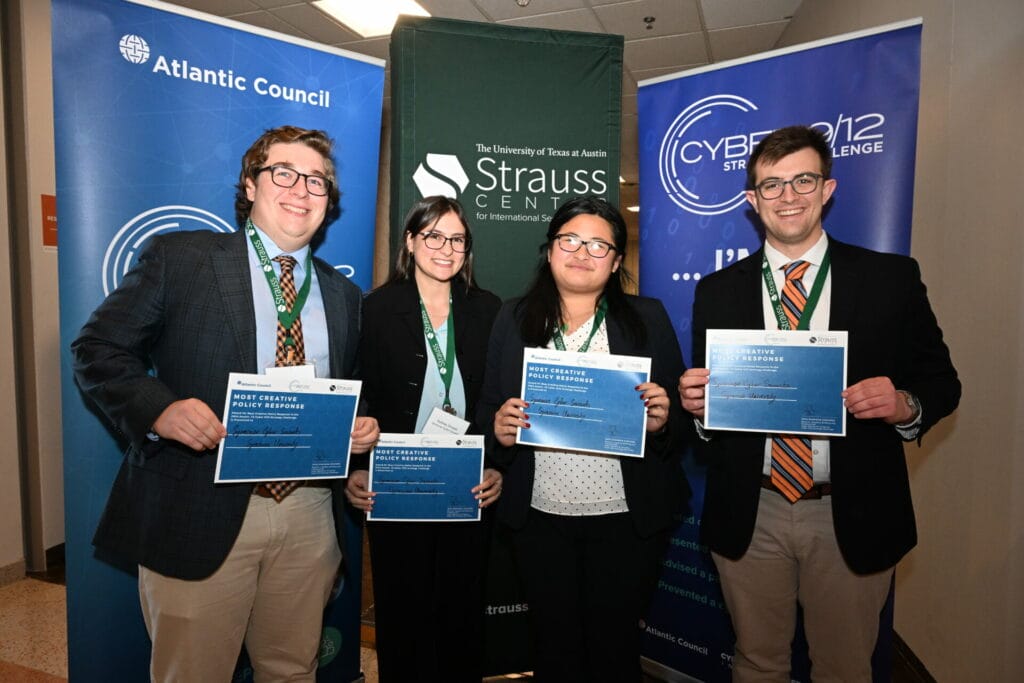
The Syracuse Cyber Savants of Syracuse University were awarded “Most Creative Policy Response”.
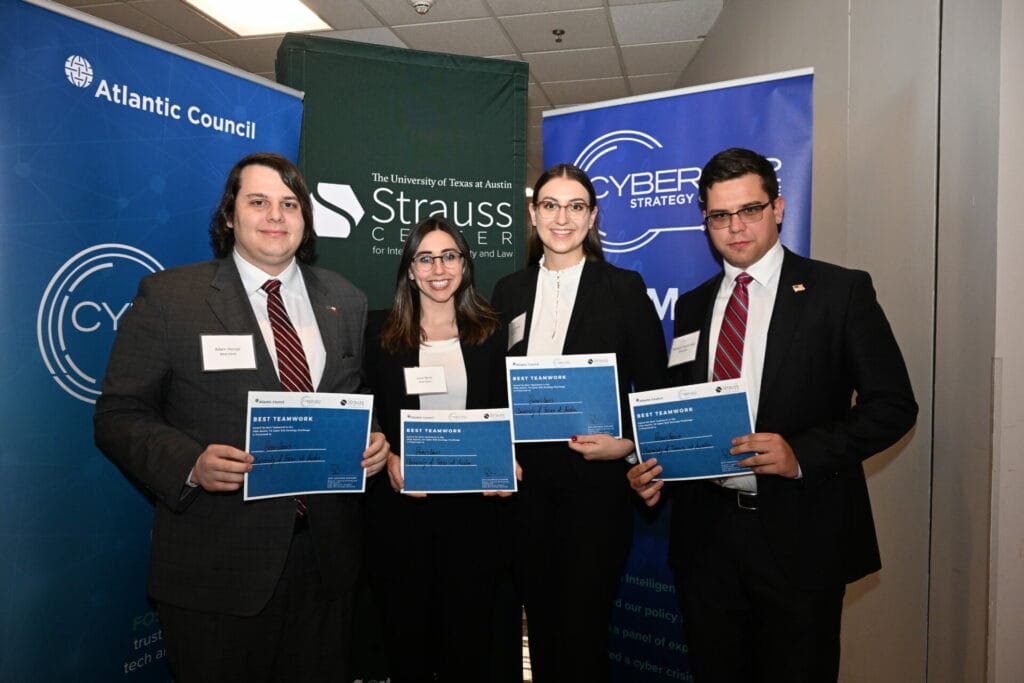
The Bearclaws of the University of Texas at Austin were awarded “Best Teamwork”.
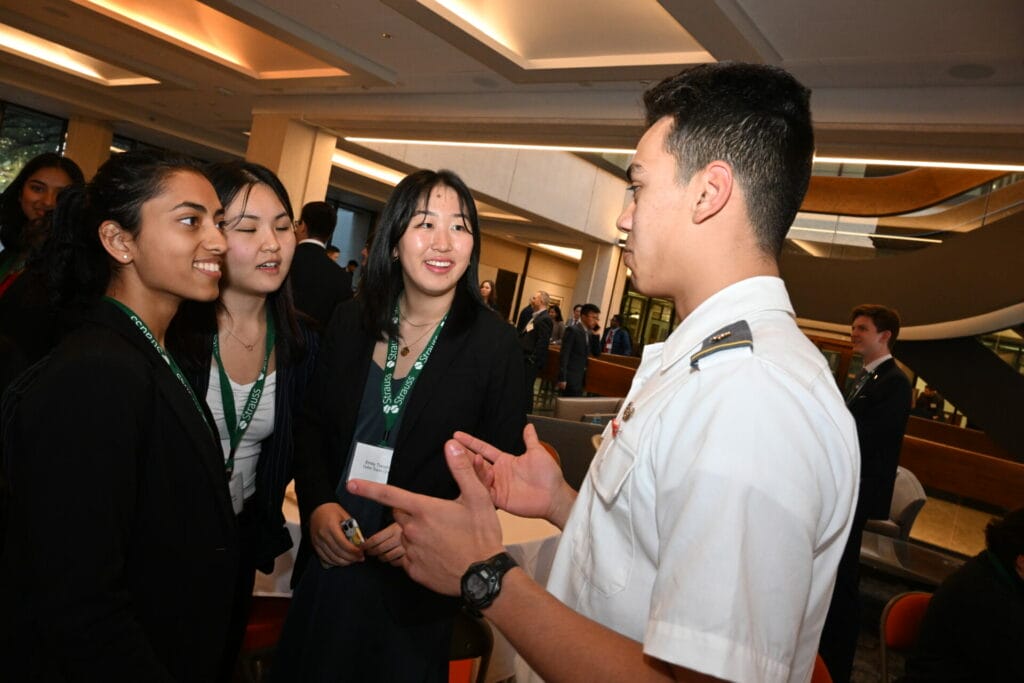
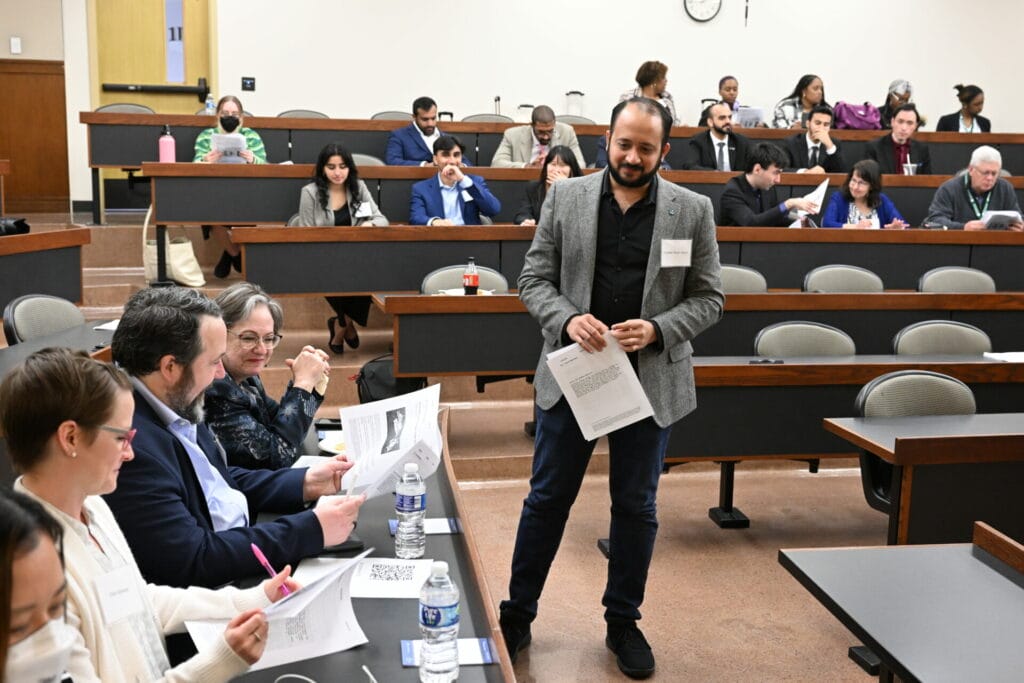
The second day of competition began with the semi-final round, where teams grappled with new issues introduced to the Cyber 9/12 scenario. Students were able to network with cybersecurity and national security experts from the public and private sectors, in one-on-one and in group discussions. Students were also able to network with one another.
The final round challenged three teams with surprise updates to the evolving cybersecurity scenario, where they were given fifteen minutes to learn of the updates and prepare a brief. Out of twenty-three original teams, the following teams won the 2024 Austin Regional Cyber 9/12:
The Duke Phishermen of Duke University were awarded 1st place, a $2000 award, and passes to Black Hat USA 2024. The Duke Phishermen are comprised of Peter Banyas, Shristi Sharma, Atharva Vispute, and Lucas Wagner.
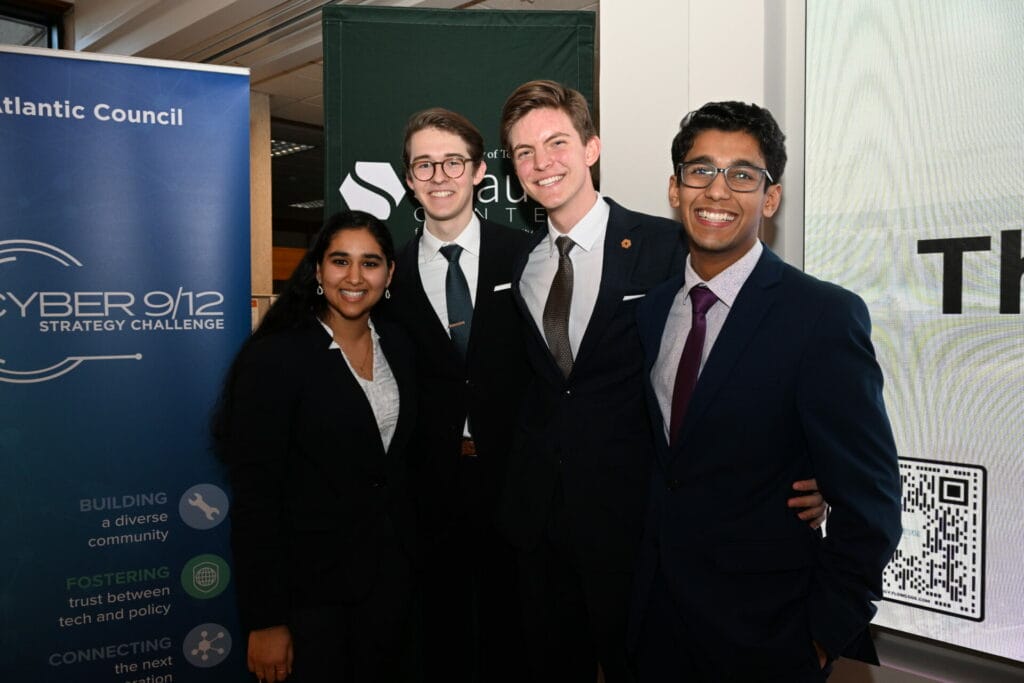
Kernel Exploit of the University of Illinois Urbana-Champaign were awarded 2nd place, a $1000 award, and an Atlantic Council Cyber Statecraft Initiative board game. Kernel Exploit is comprised of Piotr Biel, Anthony Leapo, Joshua Moore, and Harry Wang

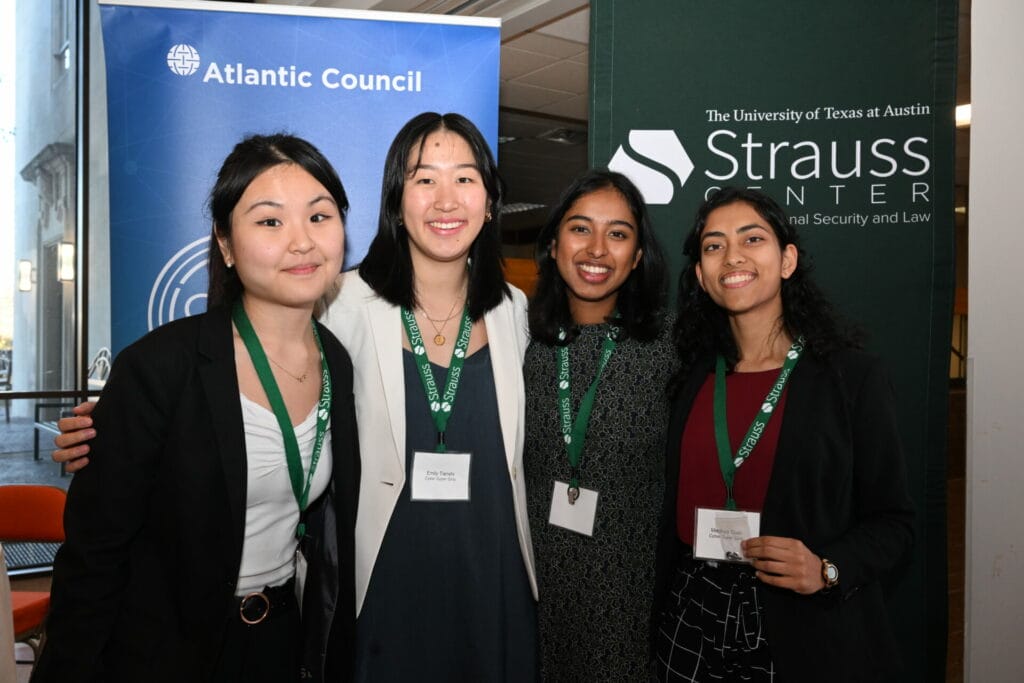
The Cyber Super Girls of Stanford University were awarded 3rd place and a $500 award. The Cyber Super Girls are comprised of Medhya Goel, Rebecca Joseph, Megan Mou, and Emily Tianshi.
The 2024 Austin Regional Cyber 9/12 was another successful Cyber 9/12 competition featuring more teams than any previous Austin competition, one international team, and some of the highest quality briefs that the Strauss Center and Atlantic Council have seen in a Cyber 9/12 competition.
How does the competition work?
This is a simulation-based, judge-graded competition in which teams consisting of three to four students (who can be either graduate students or undergraduate students, from any disciplinary background) collaborate to provide policy analysis and recommendations in response to an evolving, fictional fact-pattern relating to cyber crisis and conflict. The competition is designed to reward substantive knowledge across a range of areas, including any number of policy domains as well as insights from technology, business, and law. And of course, the competition also rewards both written and spoken communication skills. The event is on the record and proceedings may be photographed and recorded for public use.
More specifically:
Each team will draft written policy briefs in response to this initial scenario, and those written responses must be submitted at a later determined date. The first-round grade will be determined by the oral presentations that will then occur on the competition’s first day. The oral presentation for each team begins with a ten-minute presentation to judges, followed by ten minutes of answering questions from the judges. The judges’ score of the qualifying round oral presentations will be combined with the team score from the more detailed written policy brief submitted in advance of the competition, and approximately 50% of teams will advance to the semi-final round on day two based on those combined results.
We will announce the semi-finalists at the end of day one, and at that point, we also will distribute an updated intelligence report that expands upon the original scenario. The semi-finalist teams will then have the evening to refine and amend their analysis as they deem appropriate, with a new round of oral presentations taking place beginning on day two. Three finalist teams will be selected based on the results of that round, and at that point they will receive a third and final intelligence report, detailing further changes to the scenario. The finalist teams will have only a very short amount of time to use the new information to revise their policy responses. The finalists then will deliver a ten-minute oral presentation, followed by ten minutes to answer direct questions from a panel of judges.
Preparation materials, including a starter pack for your team and past competition scenarios featuring award-winning policy recommendations can be found on Atlantic Council’s website here.
Who can participate?
You apply as a team. Each team must have at least three, but no more than four, student members. Anyone who is a current student at the graduate or undergraduate level, without respect to the nature of your degree program, qualifies. Each team also must identify a faculty member or other professional who will serve as their coach. The coach is welcome to but not required to attend the event. We welcome students from non-US universities to apply, however, students must be able to be present in-person at the local competition time. If your team cannot confirm a member of faculty to coach your team, please let us know and we can assist with identifying a cyber practitioner familiar with Cyber 9/12 to support your team.
What is the prize?
There are cash prizes for the student members of all three teams that reach the final round of the competition. The overall winning team will receive a total $2000 honorarium. The second-place team will receive $1000. The third-place team will receive $500.
What is the application process?
Applications will open Friday, October 13th and will close at 11:59pm, Friday, December 1st. Register here or learn more about the registration process and other Cyber 9/12 challenges with the Atlantic Council.
Do we have to pay to participate?
No, the event itself is free. The Strauss Center and the Atlantic Council will bear all costs for hosting and orchestrating it, including providing breakfast, lunch, and snacks on January 27-28th. Teams will have to cover travel themselves.
How does this relate to the “national” Atlantic Council competition?
The winning team is guaranteed admission to the national competition, hosted by the Atlantic Council in Washington, DC, later in the spring. The other teams of course remain free to apply for admission to the national competition as well. For more details on the national competition, click here.
I have other questions. Who can I contact?
For further questions about the Austin Regional, please contact Susan Crane from the Strauss Center.