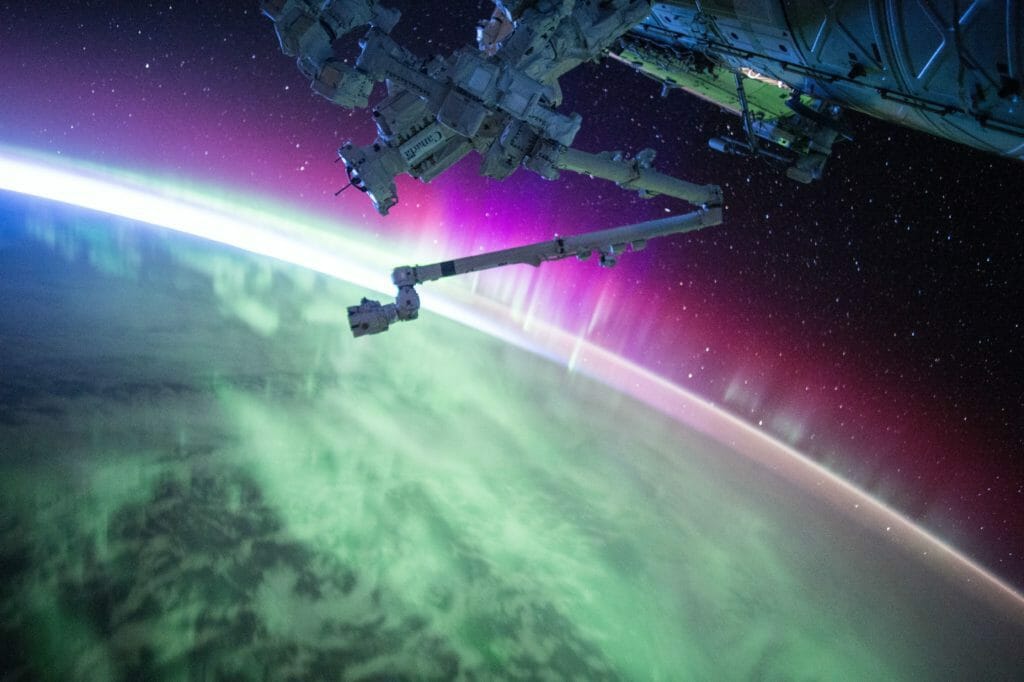
On Tuesday, September 21, the Strauss Center welcomed Charity Weeden, Vice President of Global Space Policy and Government Relations at Astroscale, to discuss “Actively Cleaning Outer Space: A Need for Predictability and Transparency of the Trackable Anthropogenic Space Object Population.” Ms. Weeden’s talk explored the need for accurate measuring of risk in the consideration of licenses for space activities and the emerging challenges in characterizing space operations. Ms. Weeden’s talk also addressed collision probability, capping risk, monitoring, and enforcing rules as well as the trends in “transparency” for satellite operators. This talk was part of our Brumley Speaker Series.
During her opening remarks, Ms. Weeden shared her professional and personal relationship to space and how she ended up in the field. She illustrated the ways space operations can affect everyone’s daily lives and the importance of space sustainability. She highlighted the influence of significant space events, such as the 1986 Challenger crash and the 2009 Iridium-Cosmos collision, on not only her perspective of space sustainability but on others, like that of the Astroscale CEO, Nobu Okada.
Ms. Weeden also spoke on the ways in which Astroscale frames space sustainability into three pillars: Space Situational Awareness, Space Traffic Management, and Space Environmental Management. The latter being a new proposition to expand how governments and stakeholders approach minimizing the growth of the space debris population through preventative or remedial action. The end goal for Ms. Weeden is a space environment where the risk to operations is known, controllable, and limited without affecting the growth in space activity.
Biography
Ms. Charity Weeden is Vice President, Global Space Policy at Astroscale U.S., coordinating and synchronizing Astroscale’s global policy efforts towards spaceflight safety and long-term space sustainability.
Ms. Weeden brings a rich experience as an operator, manager, diplomat, and advocate for the space community. Prior to Astroscale, she established a consulting company dedicated to supporting new space companies navigate the U.S. regulatory environment. Ms. Weeden was previously Senior Director of Policy at the Satellite Industry Association (SIA), responsible for advancing U.S. satellite industry interests in government services, regulatory, legislative, defense, export-control, and trade. Prior to SIA, Ms. Weeden served as the Canadian Embassy Assistant Attaché for Air and Space Operations, where she facilitated Royal Canadian Air Force (RCAF) space engagements with the U.S. Government, industry, and the Embassy community.
Ms. Weeden is a 23-year veteran of the RCAF, starting her career as a CP-140 (P-3) maritime patrol Air Navigator conducting airborne maritime surveillance operations, followed by assignments as Deputy Sensor Manager for the U.S. Space Surveillance Network at U.S. Air Force Space Command, policy officer at NORAD and USNORTHCOM, and as Flight Support Operations Manager at the Canadian Space Agency. Ms. Weeden currently serves as Chair of the FAA Commercial Space Transportation Advisory Committee, is a fellow at the Canadian Global Affairs Institute, and volunteers as a mentor for the Brooke Owens Fellowship.
Ms. Weeden received her undergraduate degree in Mechanical Engineering from the Royal Military College of Canada and a master’s degree in Space Science from the University of North Dakota. She is an alumnus of the International Space University Summer Session Program.