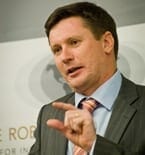
American Power and Asia’s Uncertain Future: An Alliance Perspective
The Robert S. Strauss Center for International Security and Law welcomed Andrew Shearer, Director of Studies and Senior Research Fellow at the Lowy Institute for International Policy, on May 4, 2011. Will Inboden, Strauss Center Distinguished Scholar, introduced Mr. Shearer.
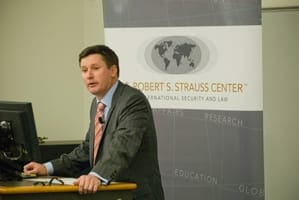
Mr. Shearer kicked off the discussion by congratulating U.S. intelligence agencies and military forces for the recent, successful operation that caused the death of Osama bin Laden. For decades, global power has been concentrated in the United States and, by extension, its strategic allies. However, current trends, particularly the growth of India and China, pose an unprecedented threat to the United States’s global dominance.
Mr. Shearer surveyed the current state of affairs in Asian nations, outlining a number of trends that portend, to many, the impending rise of China. Mr. Shearer, however, is more optimistic about the ability of the United States and its allies to respond to the challenges posed by China, citing instability within China, China’s problematic alliances (e.g., Myanmar and North Korea) and generally coercive foreign policy, and U.S. and Australian policy developments as sources for his “quiet confidence.”¬ù
There is no need for the United States and its allies to come to any premature accommodation with China in the next decade. The key, Mr. Shearer argues, is for the United States to maintain its assertiveness in Asia, restore its economic strength, and reassure its alliances of its commitment to honoring its existing collective security obligations. Generally, the United States must continue to strengthen and diversify its alliances in Australasia. But the United States should not be solely responsible for building these alliances; South Korea, Japan, and Australia each need to address internal concerns to play a meaningful role in ensuring future peace and stability in Asia.

Mr. Shearer fielded questions from the audience regarding the drivers underlying China’s foreign policy, whether China’s interests are indeed antithetical to the U.S. and its allies, the possibility for future cooperation with China, the autonomy of the People’s Liberation Army in the Chinese government, and nuclear proliferation.
Andrew Shearer has extensive international experience in the Australian Government, most recently as foreign policy adviser to former Prime Minister John Howard. Previously he occupied a senior position in the Australian Embassy in Washington DC and was strategic policy adviser to former Defense Minister Robert Hill. He occupied various positions in the Department of Foreign Affairs and Trade, the Department of the Prime Minister and Cabinet, and the Office of National Assessments. Shearer has honors degrees in Arts and Law from the University of Melbourne. He was awarded a UK Foreign and Commonwealth Office Chevening Scholarship and has an MPhil degree in international relations from the University of Cambridge.
Watch the full presentation below: