
Bad Debts: Assessing China’s Financial Influence in Great Power Politics
Dr. Eugene Gholz, Distinguished Scholar at the Strauss Center and Associate Professor at the LBJ School of Public Affairs, welcomed Dr. Daniel Drezner, Professor of International Politics at The Fletcher School, Tufts University, to speak on China’s financial influence in great power politics on November 19, 2009.
“If you owe a couple of billion dollars to China, it’s your problem; but if you owe $2.3 trillion, it is China’s problem,”¬ù said Dr. Drezner. Against a backdrop of enormous U.S. debt to China, Dr. Drezner discussed the geopolitical implications of China’s creditor status. He argued that it is not in China’s interest to use the monetary power as a geostrategic tool. China has stakes in U.S. assets and its economy still relies on U.S. imports. Unless China has better alternatives, decoupling its dependence on the U.S. economy is difficult. He further argued that the issue of replacing the dollar as the main reserve currency is still far-fetched in the present context.

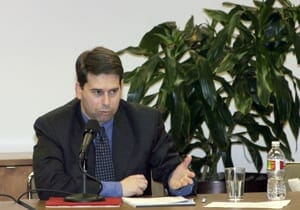
During the question and answer session following his presentation, Dr. Drezner presented his arguments on the pros and the cons of China using its financial power card. Further, he fielded questions on China’s naval building program, U.S. treasury bonds, China’s consumption pattern, the dollar carry trade, China’s interest in U.S. policies, its growing role in international financial institutions and its tax policies.
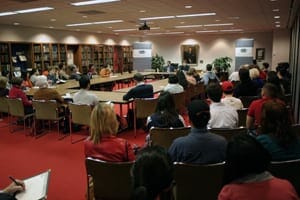
Daniel W. Drezner is professor of international politics at the Fletcher School of Law and Diplomacy at Tufts University and a senior editor at The National Interest. Drezner has received fellowships from the German Marshall Fund of the United States, the Council on Foreign Relations, and Harvard University. He is the author, most recently, of All Politics is Global: Explaining International Regulatory Regimes (Princeton University Press, 2007), which explores how and when regulatory standards are coordinated across borders in an era of globalization. Drezner writes a widely read foreign affairs blog at http://drezner.foreignpolicy.com.
This presentation was part of the Strauss Center’s International Security Speaker Series, which features leading scholars and policy practitioners discussing challenges and solutions for meeting the security demands of the modern world.
Watch the full presentation below: