Cybersecurity: Threats and Responses
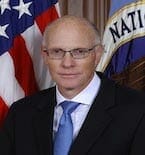
On Tuesday, October 22, 2018, the Intelligence Studies Project and Strauss Center for International Security and Law welcomed George Barnes, Deputy Director of the National Security Agency, who spoke on cybersecurity threats and other national security challenges facing the United States at the Lyndon B. Johnson School of Public Affairs.

More photos from the event can be found here.
Deputy Director Barnes opened his remarks by highlighting that Americans have always stood by our ideals and were “brought together by our Constitution but that “the world around us is changing.” He argued that the traditional strengths of American society such as a free and open society, government checks and balances, the separation of church and state, and free-market capitalism were being exploited as weaknesses. He then listed the five states that are working to exploit our weaknesses: China, Russia, North Korea, Iran, and violent non-state extremist groups. Of these threats, Deputy Director Barnes noted that only one of them possessed both the strategic vision and resources to upset the current balance of power – China.

In regard to cybersecurity, Deputy Director Barnes commented that all of the foreign actors including violent extremist groups have increasingly leveraged the competitive advantage cyberspace offers for projecting power. In response, the NSA and the intelligence community as whole has shifted much of its focus to countering cybersecurity threats.
Deputy Director Barnes highlighted the expanding role NSA’s mission partners play, including private companies. Natural allies such as DOD’s CyberCom, which was “built out of the side of NSA,” and other intelligence agencies are collaborating with private companies to address cybersecurity threats.

In the wake of the Edward Snowden leaks the role of NSA changed, according to Deputy Director Barnes. For the last fifty-plus years the NSA was able to operate largely out of the public view. After the Snowden leaks, however, the NSA “had to have a foot on the outside,” with public perception becoming a more central consideration.

Deputy Director Barnes concluded his remarks by fielding questions from students and community members. Questions ranged from election security, to the US government organization to meet current and future cybersecurity threats, to the “defense forward” posture outlined in the Department of Defense’s Cybersecurity Strategy.

Mr. George C. Barnes serves as the Deputy Director and senior civilian leader of the National Security Agency (NSA). In this capacity, he acts as the NSA’s chief operating officer, responsible for guiding and directing operations, studies, and policy.
Having joined the NSA in 1987, Mr. Barnes has held a number of critical technical and operational leadership roles throughout his career, to include: Deputy Chief of the SIGINT Development Strategy and Governance organization and Chief of Data Acquisition, NSA’s SIGINT access, collection, and exploitation organization. Prior to his appointment as NSA’s Deputy Director, Mr. Barnes held the position of NSA Director of the Workforce Support Activities Directorate where he was responsible for ensuring the effective training, security and counterintelligence, and installations and logistics.
Mr. Barnes is a certified Cryptologic Engineer with a Bachelor of Science in Electrical Engineering from the University of Maryland. His professional recognition has included the prestigious National Intelligence Medal of Achievement, a Meritorious Civilian Service Award, the NSA Ann Caracristi Award for Operations and Production Excellence, an Intelligence Community Leadership Collaboration Award, and Distinguished and Meritorious Executive Presidential Rank Awards.