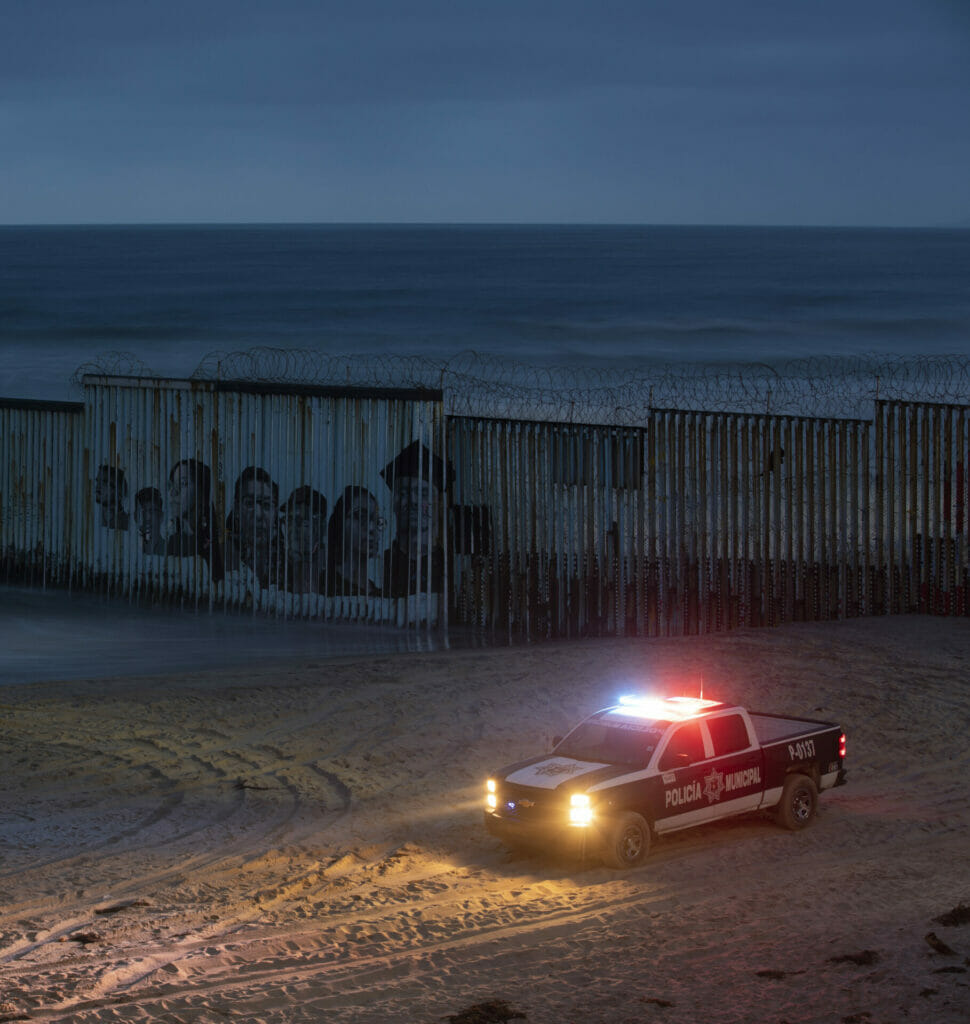
On Thursday, October 6, the Strauss Center welcomed Dr. Tony Payan, the Françoise and Edward Djerejian Fellow for Mexico Studies and Director of the Center for the United States and Mexico at Rice University’s Baker Institute for Public Policy, for a conversation on the evolution of organized crime in Mexico. This event was held at the LBJ School of Public Affairs as part of the Strauss Center’s Brumley Speaker Series.
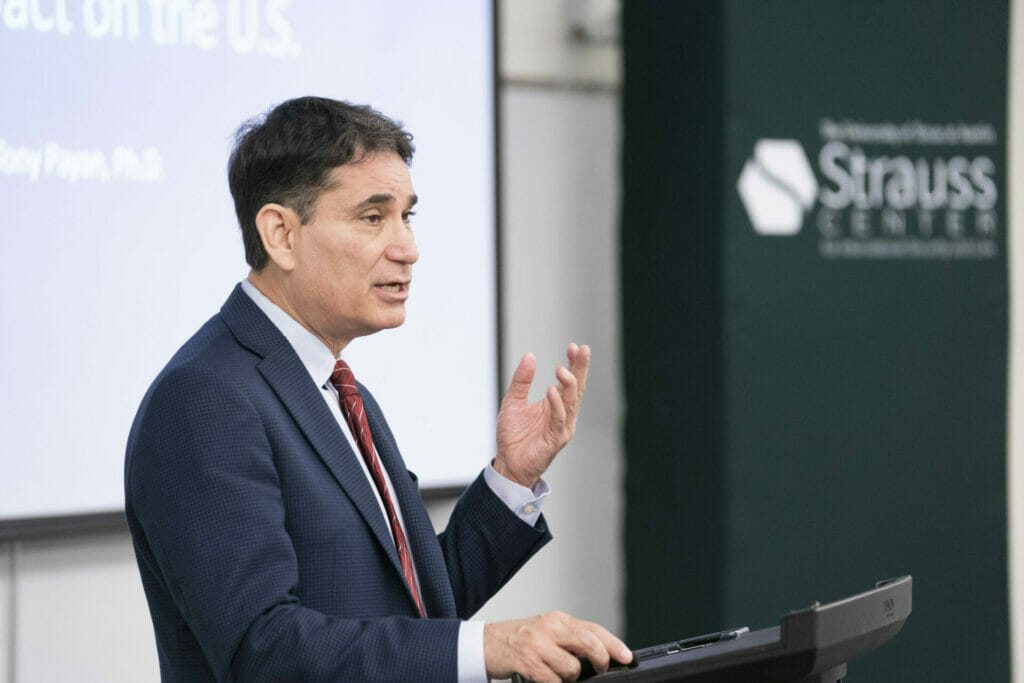
In his presentation, Dr. Payan argued that Mexican criminal organizations are now more resilient, more expansive (in terms of their reach and power), and more deadly than they were twenty years ago. He began by walking the audience through a timeline of Mexican security policy in the 21st century to demonstrate that successive administrations have continued to wage the war on drugs through a militarization strategy, even as it has failed to effectively counteract organized crime.
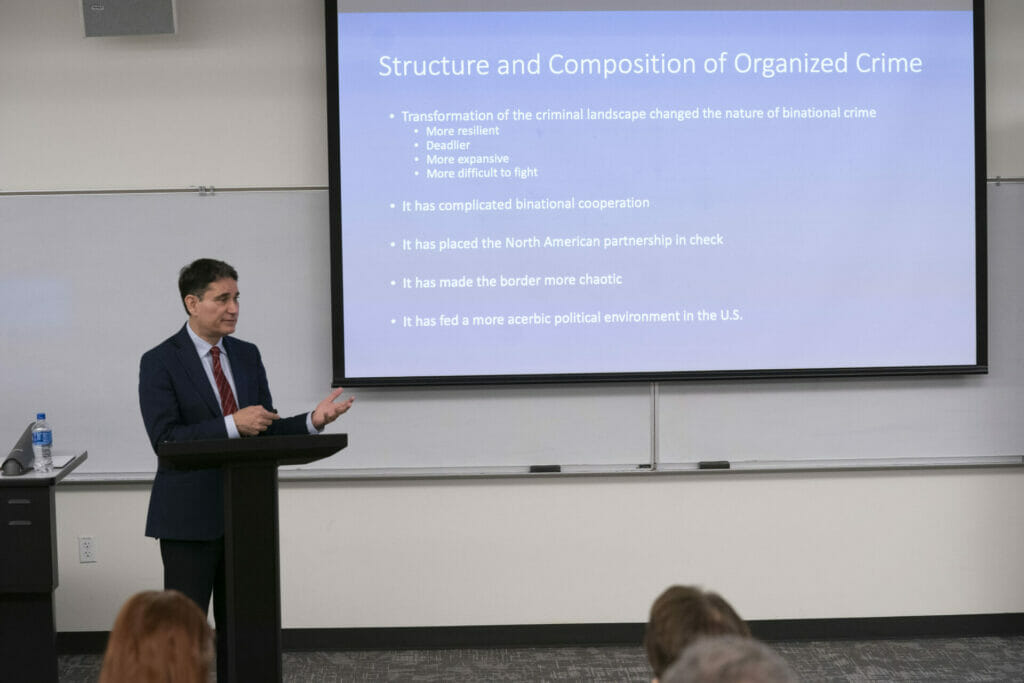
According to Dr. Payan, this strategy resulted in widespread violence throughout the country as criminal organizations became fragmented and members fought each other for control. Although President Andrés Manuel López Obrador (AMLO) was elected in 2018 on a public security platform of anti-corruption and demilitarization – with his infamous “hugs, not bullets” slogan – during his time in office he has relied on the military and embraced cartels. Dr. Payan warned that, as a new Mexican presidential campaign approaches, the next leader of Mexico will have the challenging task of tackling the deteriorating security state in the country and resurrecting the bilateral relationship with the United States.
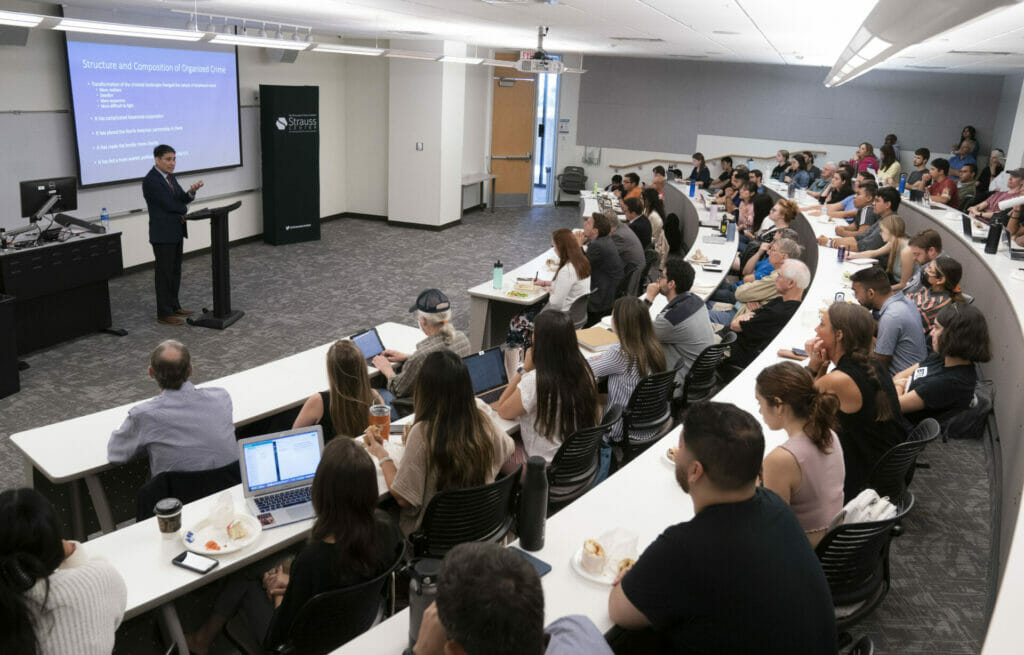
This event was free and open to the public, attended by members of the UT community, along with students, faculty, and staff from across the Forty Acres. Special thanks to Brumley mentor Tim Langford and Brumley Fellow Igor Magalhães for moderating this event.
Biography
Tony Payan, Ph.D., is the Françoise and Edward Djerejian Fellow for Mexico Studies and director of the Center for the United States and Mexico at Rice University’s Baker Institute for Public Policy. He is also a professor of social sciences at the Universidad Autónoma de Ciudad Juárez in Ciudad Juárez, Chihuahua, Mexico. Between 2001 and 2015, Payan was a professor of political science at the University of Texas at El Paso.
Payan’s research focuses primarily on border studies, particularly the U.S.-Mexico border. This includes cross-border flows, both legal and illegal, as well as border governance. He also researches problems affecting the U.S.-Mexico relationship, including the security, trade, and the political and diplomatic relationship between the two countries.Payan has authored two books, “Cops, Soldiers and Diplomats: Understanding Agency Behavior in the War on Drugs” (2006) and “The Three U.S.-Mexico Border Wars: Drugs, Immigration and Homeland Security” (2006 and 2016Editions). He is currently working on an edited volume on the future of U.S.-Mexico Relations. In addition, he has co-authored and co-edited several studies of the region, and has authored numerous book chapters, monographies, policy briefs, and journal articles.
Payan has served on several boards, including the Camino Real Regional Mobility Authority in El Paso, Texas, and the Plan Estratégico de Juárez in Ciudad Juárez, Chihuahua, Mexico. He is a member of the Greater Houston Partnership’s Immigration Task Force and the Mexico Energy Task Force. He previously served as president of the Association of Borderlands Studies between 2009 and 2010.
Payan earned a B.A. in philosophy and classical languages from the University of Dallas and an MBA from the University of Dallas Graduate School of Management. He received a doctorate degree in international relations from Georgetown University in 2001.