
More Equal, Less Equal: The Reshaping of America and the World in the 1970s
The Robert S. Strauss Center for International Security and Law welcomed Dr. Thomas Borstelmann on November 11, 2013 to present the central themes of his new book, The 1970s: A New Global History from Civil Rights to Economic Inequality (Princeton University Press, 2012). Dr. Borstelmann is the Elwood N. and Katherine Thompson Distinguished Professor of Modern World History at the University of Nebraska-Lincoln.
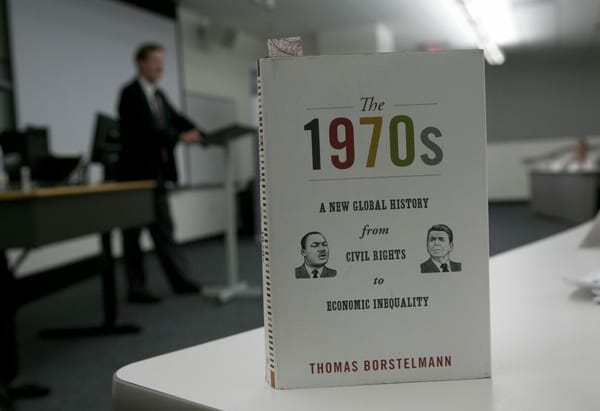
Images of helicopters crashing in a harried exit under enemy fire in Vietnam, abducted U.S. hostages in Tehran, the Watergate presidential scandal, a single-termed Gerald Ford and Jimmy Carter, endless lines at gas stations, and even disco music and fashion ” evidence of the “failures” of the 1970s. As Borstelmann argued in his introductory remarks, military, diplomatic, political, economic, and aesthetic fiascoes of this decade provoked a social anxiety of losing “what made America what it was.”
Borstelmann stated that despite the disappointments of the 1970s,√Ǭ†two major global transformations took hold during this decade, which continue to shape our lives to this day: the spread of social egalitarianism and inclusiveness, and the rising enthusiasm for free-market principles in shaping public policy. These trends, however, led to the paradoxical result of a “more equal,” and at the same time, “less equal,” society.
He explained how the decade leveled social hierarchies and expanded rights to large sectors of the population. Women in particular were empowered in the public and private sphere, formally gaining equal rights to pursue education and employment opportunities, as well as access to jury duty, loans, contraception, and abortion. Gays, lesbians, disabled people, and immigrant communities also benefitted from attempts to eliminate group discrimination. Dr. Borstelmann showed the impact of this trend against traditional hierarchies at a global level with the breakdown of empires in Southern Africa, Southeast Asia, and Eastern Europe, as well as the growing enthusiasm for the worldwide protection of human rights and the founding of international non-governmental organizations.
The growing disillusionment with an “activist government” that had not produced an effective set of results is what, according to Borstelmann, led to the embrace of free-market ideas by the public and policymakers alike. An all-volunteer military, a decline in overall tax rates, and deregulations of industries (e.g. airlines, communications, casinos) were the first steps. Internationally, free-markets began to topple socialism in South America (Chile and Argentina), the U.K., and to some degree even in communist China.

He concluded by highlighting how the themes of the 1970s still impact today’s life. Our society is more liberal and equal in social terms, while regulations and taxes generate discomfort and a lingering general distrust of the government. But the United States is increasingly economically unequal, as income continues to be unevenly distributed. For Dr. Borstelmann, social freedom combined with sharp income disparities represent the largest challenge to American democracy today.
His remarks in full:
A short conversation with Dr. Borstelmann on the themes of his book:
Thomas (“Tim”) Borstelmann has been the Elwood N. and Katherine Thompson Distinguished Professor of Modern World History at the University of Nebraska-Lincoln since 2003. He spent the previous twelve years as a member of the History Department at Cornell University. A native of North Carolina, Borstelmann graduated from the Phillips Exeter Academy and holds a B.A. (1986) from Stanford University and an M.A. (1986) and Ph.D. (1990) from Duke University. His research focuses on the intersection of United States domestic history and international history. His first book, Apartheid’s Reluctant Uncle: The United States and Southern Africa in the Early Cold War (Oxford University Press, 1993) won the Stuart Bernath Prize of the Society for Historians of American Foreign Relations for the best first book in American diplomatic history.
Borstelmann has also published The Cold War and the Color Line: American Race Relations in the Global Arena (Harvard University Press, 2001) and has coauthored a major U.S. history textbook, Created Equal: A Social and Political History of the United States (Pearson Longman Publishers, 4th edition, 2013). His most recent book is The 1970s: A New Global History from Civil Rights to Economic Inequality (Princeton University Press, 2012). He is currently at work on a book on how Americans have understood non-Americans across the sweep of U.S. history.