
Reports from the Field: Ground-Truthing Climate Change Vulnerability and Adaptation in Africa
On November 8, 2010, the Robert S. Strauss Center for International Security and Law hosted LBJ School students and faculty to discuss their summer field research in Africa corroborating data on climate change vulnerability gathered over the last year. Students and faculty used a variety of environmental, socio-economic and governance indicators to map climate change vulnerability in Africa at both the national and sub-national level.
Joshua Busby, Strauss Center Crook Distinguished Scholar and LBJ School Assistant Professor, welcomed audience members and introduced students Jared Berenter, John Peterek, Ariel Schwartz and Todd Smith. Busby described the students’ travel to vulnerable areas to “ground-truth”¬ù climate change findings through a series of on-the-ground interviews with academics, international and regional organizations, bilateral donors, NGOs, government officials and private sector leaders.
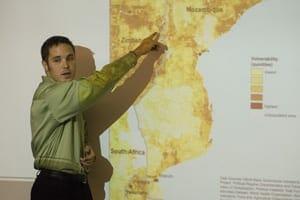
The students discussed the status and threats posed by climate change within the countries they visited and then turned their attention to describing the adaptation activities taking place within countries. All of the students noted that their field research generally supported the initial data findings.
Ariel Schwartz shared findings from her research in Tanzania and Kenya, noting the difficulty of determining what problems are attributable to climate change, rather than other human activities. She described recent climate-related changes, including an increased incidence of bacteria and diarrheal diseases around Lake Victoria, and also explained that climate change aid should be additional to existing aid flows and fully incorporated into a nation’s development plan.
Jared Berenter traveled to Mozambique and found that drought, flooding and cyclone activity posed the greatest threats to the country. He predicted that the agriculture sector, which employs a large proportion of the population, would be severely impacted. He also highlighted simple but effective efforts, such as digitalizing meteorological data, being undertaken by the nation.
John Peterek presented on his time in Malawi, where he confirmed that the highly populated and mainly agricultural Southern region was the most vulnerable to the impacts of climate change. He found that donor agencies were successfully coordinating their efforts to deal with climate change and the government was also being proactive, constructing regional food silos to deal with droughts, among other efforts.
Todd Smith spent time in South Africa, Tanzania, Zambia and Zimbabwe. He noted two main drivers of vulnerability: food insecurity and the impact of floods and rain variability, adding that the urban poor are the most vulnerable. He cautioned that the world could no longer assume that the climate is constant, emphasizing the necessity of adaptation activities.

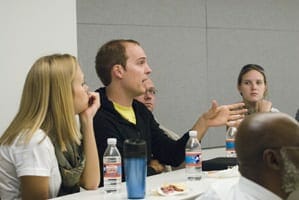
The presenters fielded questions from the audience regarding the process for selecting and conducting interviews, the metrics for the final analysis, the focus on international donors rather than local actors, and the difficulties of measuring governance.
This presentation was part of the Strauss Center’s program on Climate Change and African Political Stability (CCAPS), which seeks to better understand the relationship between the growing threat of climate change and the ability of African countries to respond. For more information, please visit http://ccaps.strausscenter.org/.
Watch the full presentation below: