
Responding to International Waves of Political Change: US Foreign Policy and 1989
The Robert S. Strauss Center for International Security and Law, in partnership with the Rethinking Diplomacy initiative, welcomed Mary Sarotte, Professor of History and International Relations at the University of Southern California, on November 17, 2011. Strauss Center Director, Francis J. Gavin introduced Dr. Sarotte.
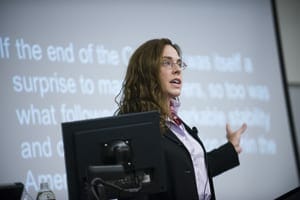
Dr. Sarotte began by summarizing the research process and content of her latest book, 1989: The Struggle to Create Post-Cold War Europe. Her book examines how the world and international relations changed after the year 1989. She detailed three recent research efforts on the Post-Cold War world, and how her book differentiates from their theories and approach.
Dr. Sarotte described some key historical events, which she identified as “punctuation moments”¬ù that redefine the world’s “equilibrium.”¬ù Sarotte argued that not much changed in international relations after the Cold War ended. Most of the leaders of protests from the Eastern Europe revolutions disappeared after the Cold War, leaving experienced international leaders to take over again during reconstruction.
After her general overview of historical events, Dr. Sarotte asked the audience to consider some open questions about the world after the fall of the Berlin Wall. She suggested that to answer these questions one must conceptualize the immediate post-Cold War period as an architectural competition between models of political order.

She described four architectural models for this framework. The first “restoration,”¬ù would reproduce the quadripartite mechanism of the U.S. Britain, France and the Soviet Union. In the next, “revivalism,”¬ù the Germanies would maintain their own political and economic orders, but operate under one roof. The third, “heroism,”¬ù meant integrating the Soviets (and Russians) into pan-European and pan-Atlantic institutions. Finally, “pre-fab,”¬ù would take the pre-existing western model and duplicate it in the East. Sarotte believes the fourth model, pre-fab, was used.
Questions from the audience covered why Gorbachev’s vision for post-cold War Europe was not possible, America’s fear of being left out as a power in Europe, and Sarotte’s critique on the U.S. use of real politique.
Watch the full presentation below: