
SXSW Interactive Workshop on Privacy, Surveillance, and the NSA
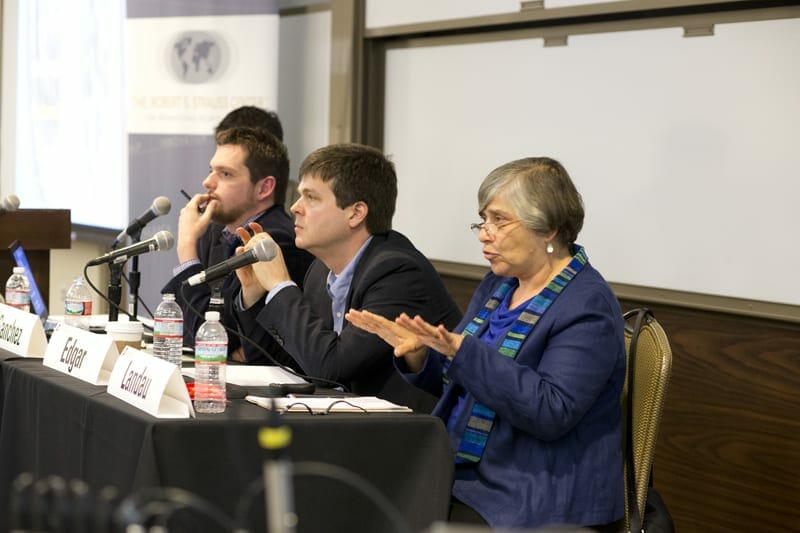
On March 8th, the Robert S. Strauss Center held its first ever South-by-Southwest Interactive Workshop at the AT&T Center in Austin, TX. The workshop titled “After Snowden: Privacy, Surveillance, and the NSA” featured Strauss Center director Robert Chesney; Timothy Edgar of Brown University’s Watson Institute; Susan Landau, author of Surveillance or Security? and Privacy on the Line; and the Cato Institute’s Julian Sanchez.
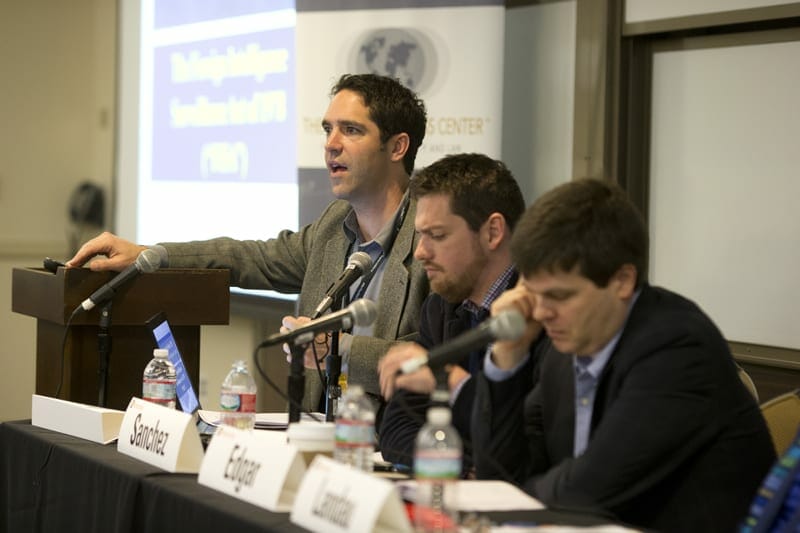
Over the last year, Edward Snowden’s dramatic revelations of classified information has set off an captivating public debate concerning the intersection of technological change, national security and privacy. As the issue has been thrust into the public discourse, many Americans have developed strong personal opinions about how the intelligence community should go about ensuring national security. Unfortunately, such polarizing debates often overlook the legal, policy, and technical aspects at the center of the programs in question. By bringing together experts in technology, privacy policy, civil liberties, law, and U.S. government intelligence policy, the Strauss Center’s SXSW Interactive session sought to provide an informed foundation for those interested in understanding the future implications of the ongoing debate.
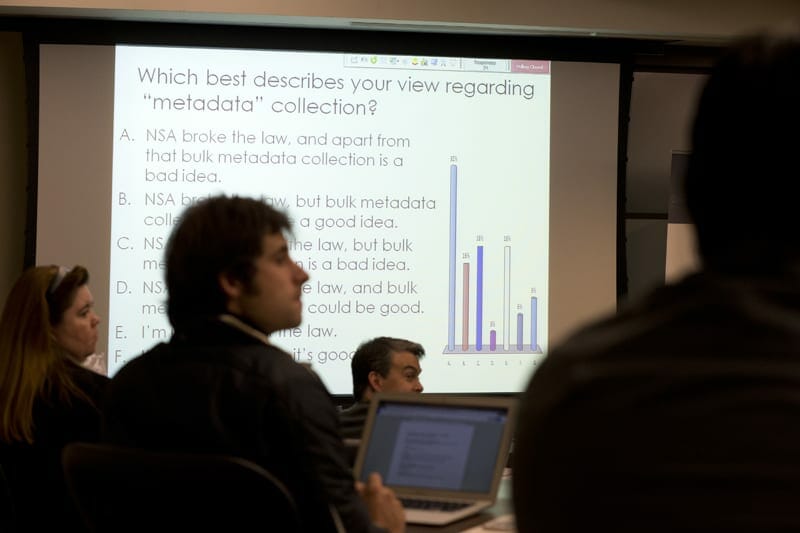
The two and a half hour session began with a polling exercise in which the audience was asked to use their handheld clickers to provide anonymous votes on a variety of questions related to Edward Snowden and the NSA’s data collection programs. The questions ranged from “Do you consider Snowden a hero or a traitor?” to “Has your view of the intelligence community changed since the events of 9/11?” The interactive polling results were displayed and the findings set the stage for the intriguing discussion that would follow.

The presentation began with an introduction by Bobby Chesney in which he discussed the history of the National Security Agency and how the agency has developed since its inception in 1952. Among the topics covered in Chesney’s presentation were landmark legal developments such as the Church Committee Reports of 1975, Executive Order 12333, and the Foreign Intelligence Surveillance Act (FISA) of 1978. Chesney also provided a detailed explanation of more technical issues undergirding the debate such as signals intelligence (SIGNIT) and metadata versus content collection.
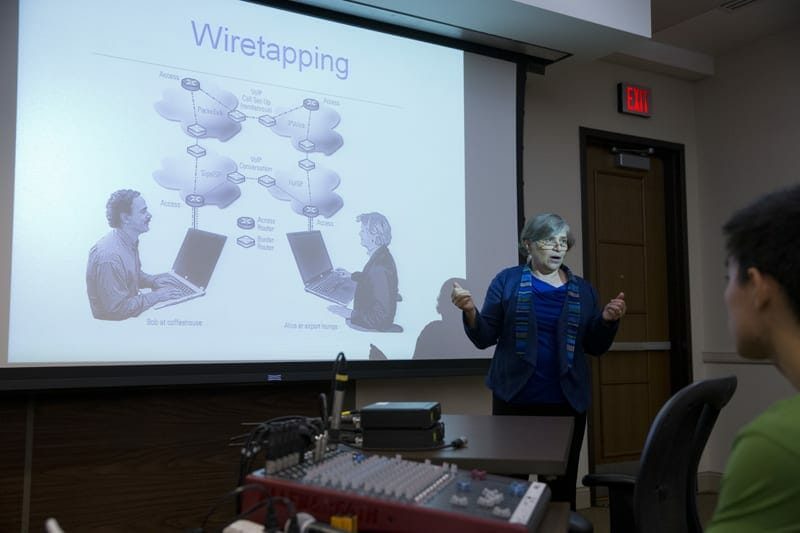
Following Chesney, Susan Landau sought to explain how spyingspecifically wiretappinghas developed throughout history. From devices once placed on land telephone lines to the complex interconnectedness of present-day telecommunications networks, Landau conveyed the challenges that intelligence officers face as they try to keep up with technological innovations.
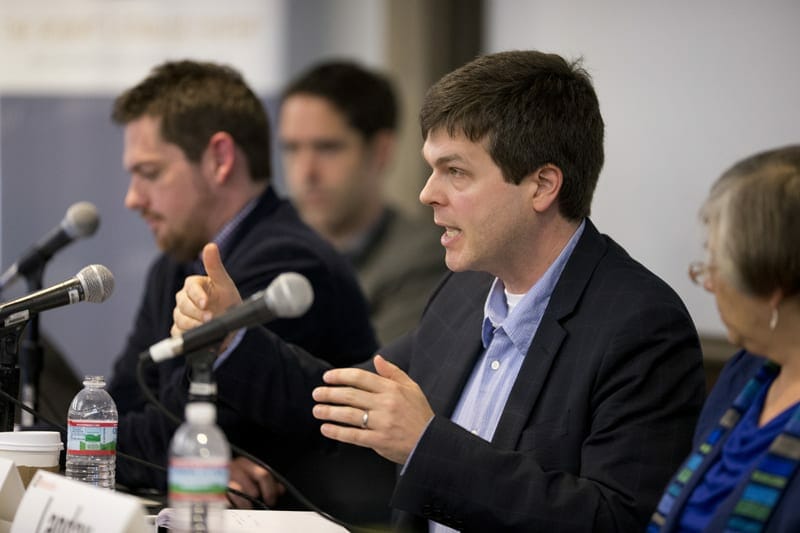
Tim Edgar of Brown University (and formerly director of privacy and civil liberties for the White House National Security Staff under the Obama Administration, and national security and immigration counsel for the ACLU) weighed in on the ways in which the U.S. government has attempted to alter legal structures in an effort to keep with rapidly changing nature of telecommunications technology. As is often the case, the U.S. intelligence community has faced an uphill battle in keeping up with improvements in technology and this is often reflected in the policiesor lack thereofthat seek to encourage oversight.

Julian Sanchez asserted that the U.S. government has come up short in its effort to balance privacy rights and national security. Sanchez noted that a combination of factors, namely poor privacy and civil liberties oversight, has led to the government wielding far too much unchecked power in matters of intelligence collection on American citizens.

While the majority of South-by-Southwest Interactive sessions focus on emerging technology and development, the Strauss Center’s workshop offered festival attendees the chance to hear from a diverse group of experts with knowledge and experience in the privacy and security environments. Audience members may have entered the interactive session with an opinion of Edward Snowden, but attendees left with a working knowledge of the organizational structure and legal framework governing the NSA’s data collection program and its implications for future privacy and security questions. As a research institution focusing on the intersection of international security and law, the Strauss Center has an inherent interest in helping the public to understand the legal, technical, and policy aspects of such polarizing debates.
Bobby Chesney
Bobby Chesney is the Charles I. Francis Professor in Law at the University of Texas School of Law, a Distinguished Scholar of the Robert S. Strauss Center for International Security and Law, and a Nonresident Senior Fellow of the Brookings Institution. He also serves as the law school’s Associate Dean for Academic Affairs. In 2009, Chesney served in the Justice Department as an advisor to the Detention Policy Task Force and previously served the Intelligence Community as an associate member of the Intelligence Science Board and a member of the Advanced Technology Board. His scholarship focuses on U.S. national security policies and institutions, including military detention, the use of lethal force, civilian criminal prosecution in terrorism-related cases, civil litigation involving the state secrets privilege, and the convergence of functions across the military and the Intelligence Community. He is a magna cum laude graduate of both Texas Christian University and Harvard Law School.
Timothy Edgar
Timothy Edgar is a visiting fellow at the Watson Institute and an Adjunct Professor of Law at Georgetown University. He served under President Obama as the first-ever Director of Privacy and Civil Liberties for the White House National Security Staff, working on cybersecurity, open government, and data privacy. From 2006-09, he was the first Deputy for Civil Liberties for the Director of National Intelligence, reviewing new surveillance authorities, the terrorist watchlist, and other sensitive programs. He was previously the national security and immigration counsel for the ACLU, where he spearheaded the organization’s innovative left-right coalition advocating for safeguards for post-9/11 counterterrorism initiatives, including the USA Patriot Act. His work focuses on policy challenges posed by growing global cyber conflict, particularly reconciling security interests with fundamental values like privacy and Internet freedom. He has a JD from Harvard Law School and AB from Dartmouth.
Susan Landau
Susan Landau is the author of Surveillance or Security? The Risks Posed by New Wiretapping Technologies (MIT Press, 2011), and co-author, with Whitfield Diffie, of Privacy on the Line: The Politics of Wiretapping and Encryption (MIT Press, 1998, rev. ed. 2007). She has written numerous computer science and public policy papers and op-eds on cybersecurity and encryption policy. In 2011 Landau testified in Congress on the security risks of wiretapping and in 2009 she testified on cybersecurity activities at NIST’s Information Technology Laboratory. Landau was previously a Distinguished Engineer at Sun Microsystems, where she worked in cybersecurity, privacy, and public policy. Landau was a faculty member at the University of Massachusetts at Amherst and at Wesleyan University. She has held visiting positions at Harvard, Cornell, and Yale, and the Mathematical Sciences Research Institute. Landau is currently a senior staff privacy analyst at Google.
Landau serves on the Computer Science Telecommunications Board of the National Research Council, as well as on the editorial boards of IEEE Security and Privacy and Communications of the ACM. A 2012 Guggenheim fellow, Landau was a 2010-2011 fellow at the Radcliffe Institute for Advanced Study, the recipient of the 2008 Women of Vision Social Impact Award, Landau is also a fellow of the American Association for the Advancement of Science and the Association for Computing Machinery. She received her BA from Princeton, her MS from Cornell, and her PhD from MIT.
Julian Sanchez
Cato Institute fellow Julian Sanchez studies issues at the busy intersection of technology, privacy, and civil liberties, with a particular focus on national security and intelligence surveillance. Before joining Cato, Sanchez served as the Washington Editor for the technology news site Ars Technica, where he covered surveillance, intellectual property, and telecom policy. He has also worked as a writer for The Economist’s Democracy in America blog, and an editor for Reason magazine, where he remains a contributing editor. Sanchez has written on privacy and technology for a wide array of national publications, ranging from National Review to The Nation, and is a founding editor of the policy blog Just Security. He studied philosophy and political science at New York University.