
The Robert S. Strauss Center for International Security and Law welcomed Dr. James Whitman on October 29, 2013 to present the main arguments of his book, The Verdict of Battle. Dr. Whitman is a Professor of Comparative and Foreign Law at Yale Law School. The talk took place in the Eidman Court Room at the UT School of Law.
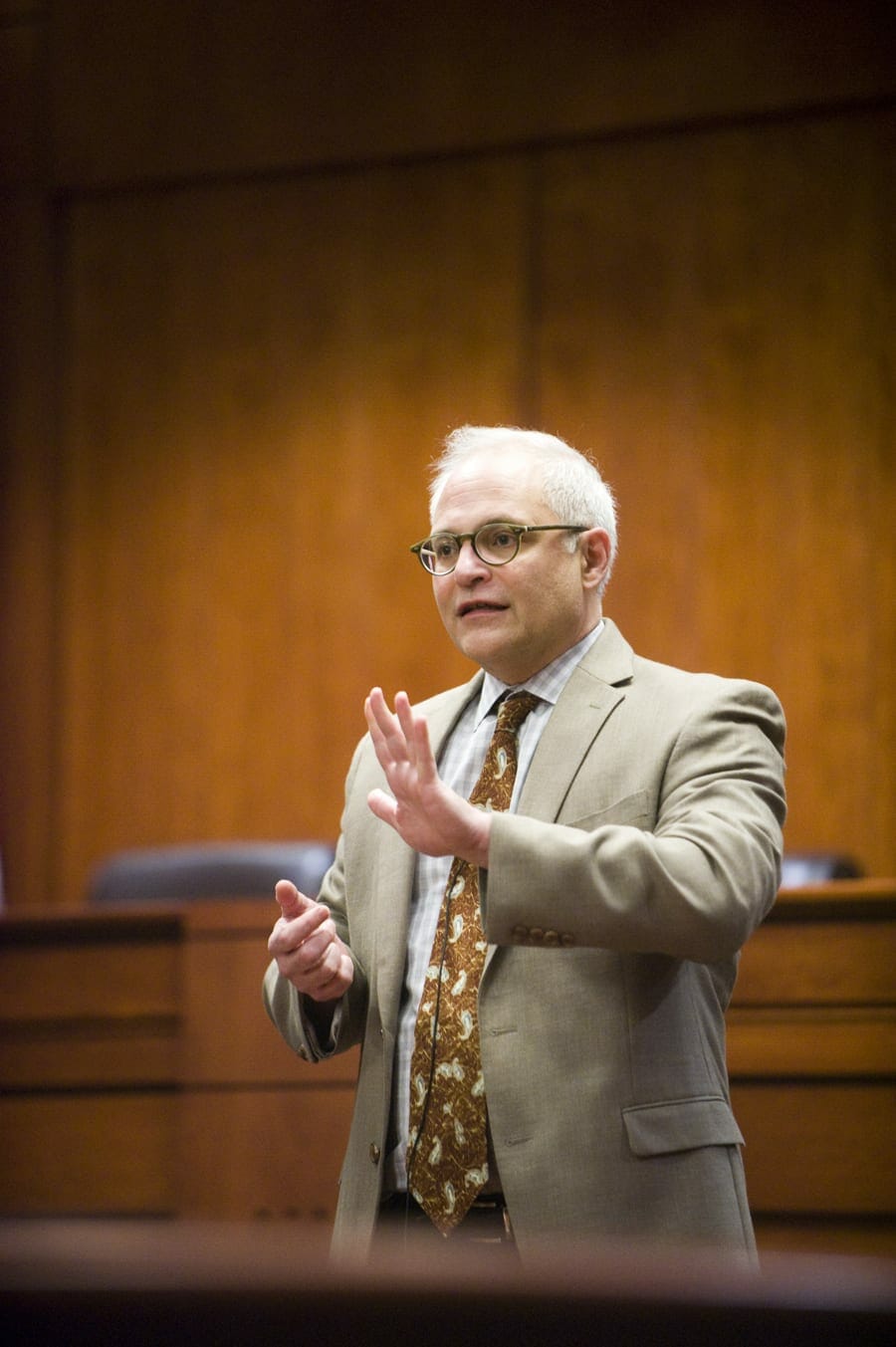
Dr. Whitman’s central claim is that pitched wars in the eighteenth century were more civilized than those of previous and following centuries. Combatants of the time considered pitched battles to be a legitimate standard operating procedure by which to settle disputes. Sovereigns agreed to a tacit contract of trial by combat and accepted the verdict and consequences of triumph or defeat on the battlefield. By resorting to this conflict resolution mechanism, warring parties limited the duration and location of war.

The notion of “chance by arms” is alien to today’s perspectives of war. Dr. Whitman mentioned that in contrast to disputes of dynastic succession, conflicts of our time are driven by “humanitarian principles.” While in the eighteenth century the fight was over material gains (e.g. a certain territory), what is at stake today are abstract “causes.” Unfortunately, by not having something material to negotiate with, post-eighteenth century wars have been hard to finish.

Dr. Whitman’s presentation concluded with how the eighteenth century style of warfare came to an end. He challenged explanations that consider the causes to be the French Revolution, advancements in military technology, and changes in aristocratic culture. For him, the Franco Prussian War (in which the French people failed to accept the result of battle) and the American Civil War (a battle of total devastation) signaled the decline of pitched battles. Fights between monarchs gave way to fights between republics, which turned out to be much more devastating. Finally, Dr. Whitman cautioned that if countries are willing to fight for democracy, they should weigh the costs against the benefits, for the resulting war will likely be long and unending”just like the wars of the twentieth century.
His remarks in full:
James Q. Whitman is Ford Foundation Professor of Comparative Law at Yale Law School, where he has taught since 1993. He has also taught at Stanford, Columbia, Harvard, NYU and a number of European Universities. In addition to The Verdict of Battle (2012), he is the author of numerous studies in comparative law, legal history, and criminal law, among them Harsh Justice (2003), The Origins of Reasonable Doubt (2008), and “The Two Western Cultures of Privacy” (2004). He holds a Ph.D. in History from the University of Chicago and a J.D. from Yale.