2021-2022 Public Attitudes on US Intelligence
ISP-Sponsored Surveys During the Biden Presidency Affirm Continued Strong Public Support for the Intelligence Community But Also Signal Growing Partisanship
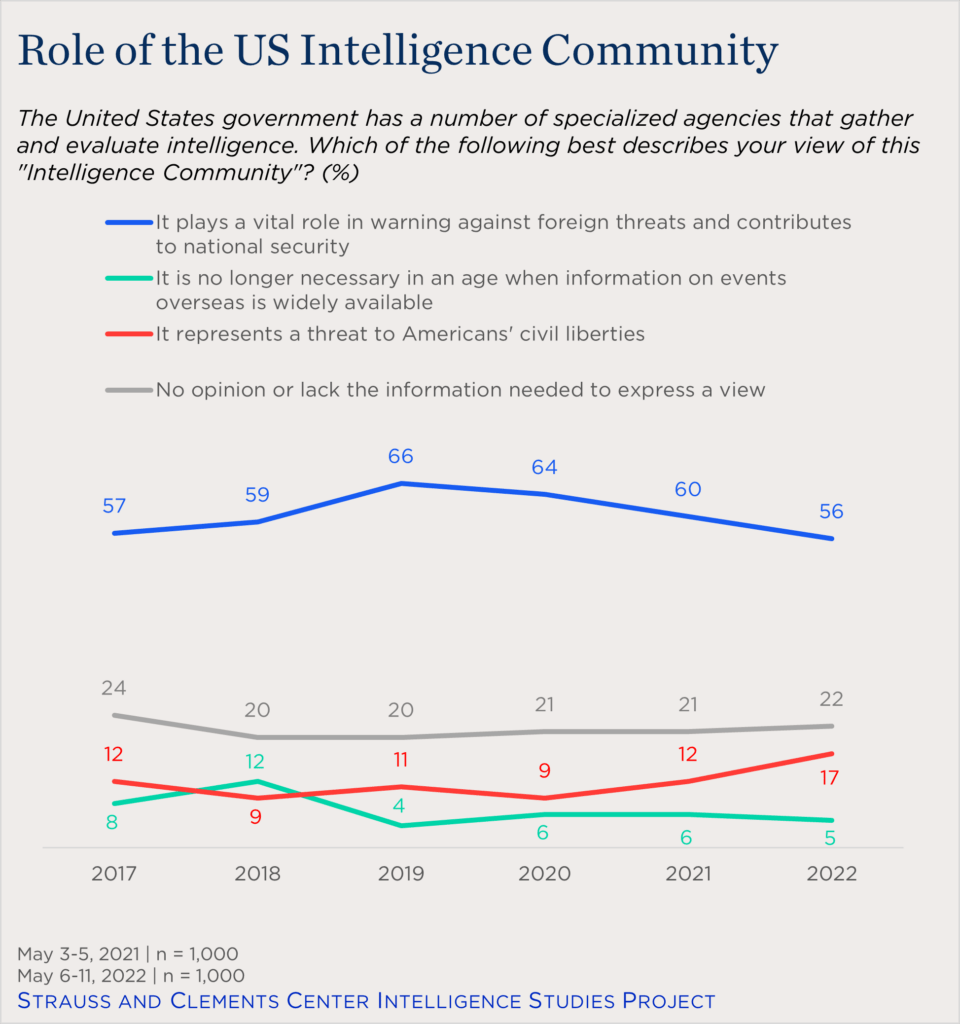
The Chicago Council on Global Affairs recently published the results of two annual polls sponsored by UT-Austin’s Strauss-Clements Intelligence Studies Project. The surveys conducted in 2021 and 2022 confirm that most Americans believe US intelligence agencies are vital to protecting the nation and effective in achieving their assigned tasks. However, they also found that partisan preference plays a significant—and growing—role in shaping public views of the Intelligence Community (IC)’s performance. Moreover, public concerns about potential violations of citizens’ privacy rights and civil liberties persist despite efforts by the IC to improve transparency and public understanding. The surveys were designed and reported by ISP Director Steve Slick, Strauss Center Distinguished Scholar Joshua Busby and ISP’s Senior Research Program Manager Kim Nguyen. Key takeaways, the conclusion, and a figure depicting overall public views on US Intelligence appear below. The full report with underlying survey data is available HERE.
Key Takeaways
- Most Americans expressed the view that the IC plays a vital role in protecting the nation—60 percent in 2021, and 56 percent in 2022.
- Few respondents believed the IC was “no longer necessary” but a sizeable, and growing, number of Americans thought the IC represented a threat to their civil liberties.
- An overwhelming majority of Americans regarded the IC agencies as highly capable in accomplishing specialized missions like preventing terror attacks and learning the plans of our adversaries. However, fewer than half of respondents believed that the intelligence agencies respected their privacy and civil liberties.
- There were notable partisan differences in views of US Intelligence. Between the 2020 and 2021 surveys—including the transition between the Trump and Biden administrations—Democrats who believed that the IC was vital increased while Republican support for the IC decreased significantly.
- Americans also appear increasingly inclined to judge the performance of the intelligence agencies based on their partisan alignment with the incumbent president.
- Respondents who “disapproved” of President Joe Biden were much less inclined to regard the IC as vital and more likely to label the IC as a threat to civil liberties.
Conclusion
The US intelligence agencies, like all other government institutions, ultimately depend on the public’s support for resources, policy impact and institutional resiliency. Earning and maintaining the public’s trust poses a unique challenge for organizations that must operate largely in secret to accomplish their missions. Our polling confirms that most Americans believe their intelligence agencies are vital to protecting the nation and effective in achieving their assigned tasks. These attitudes did not change materially with the transition from a presidential administration that was openly hostile to the IC to one that is publicly supportive of the intelligence agencies. There is also no reflection in the survey results that programs and activities aimed at increasing transparency and improving the public’s understanding of American Intelligence are having an impact. For officials designing programs aimed at explaining or correcting misperceptions about the IC, our polling highlights a persistent concern that the IC does not respect citizens’ privacy and civil liberties rights and growing partisan differences about the IC’s effectiveness and appropriate supervision and oversight.
More news from Strauss
Call for Papers: The 2026 Bobby R. Inman Award for Student Scholarship on Intelligence
The Strauss-Clements Intelligence Studies Project (ISP) at The University of Texas at Austin announces the 12th annual competition recognizing outstanding student research and writing on topics related to intelligence and national security. The winner of the Inman Award will receive a cash prize of $5,000, with two semifinalists each receiving a cash prize of $2,500. This competition is open to unpublished work by undergraduate...
2023-2024 Public Opinion on U.S. Intelligence
Strauss Center Distinguished Scholar Joshua Busby, Intelligence Studies Project Senior Fellow Stephen Slick, and Intelligence Studies Project Program Manager Kim Nyugen recently published their poll findings in Lawfare on public attitudes towards the U.S. Intelligence Community. Polling was sponsored by the University of Texas at Austin and was conducted between 2023 and 2024. Key takeaways from the polling illustrate that a...
ISP Tearline Team Reports on Russia’s Planned Naval Base Near Port Sudan
ISP’s Tearline student research team recently published an open-source report analyzing the impact of the May 2025 drone attack by the Sudanese Rapid Support Forces on infrastructure in the vicinity of Russia’s planned naval base in Sudan. The team assessed that Russia is unlikely to realize their plans for a naval base near Port Sudan in the next 6 to 12 months due to the...