Strait of Hormuz – Small Boats
Small boats have been used throughout the last century in asymmetric warfare attacks on both military and civilian targets, combating a materially superior adversary without direct confrontation. The Iranian Revolutionary Guard Corps (IRGC) operates a fleet of “˜small boats’ estimated at more than 1000 boats.[i] The Iranians harassed tanker traffic during the Tanker War using small boats. Many, including the U.S. Navy, suspect that any Iranian effort to close the Strait would include the use of small boats, potentially in suicide attacks.
- Types of Small Boats
- Countermeasures
- How Small Boats Work
- Relevant Historical Use of Small Boats
- Iran & Small Boats
Relevant Historical Use of Small Boats
Usage by the Liberation Tigers of Tamil Eelam (LTTE)
In recent years, the Liberation Tigers of Tamil Eelam (LTTE) have conducted several attacks using small boats in swarming formations and in suicide missions. They maintain a special force dedicated to carrying out these missions, the Sea Tigers or Sea Black Tigers.[ix] The LTTE use speedboats as well as mirage-class fiberglass vessels (50 feet long x 16 feet wide) to carry out these attacks.[x]
Typically, the Tigers arm their boats with machine guns or rocket propelled grenades. Alternatively, for suicide missions, they pack up to 200 pounds of explosives into the bow and fit the boat with a steel spike to penetrate the target ship’s hull.
In October 2001, the Sea Tigers attacked the M/V Silk Pride, a product tanker carrying more than 650 tons of diesel and kerosene.[xi] Five small boats were used in the attack, several of which punctured the tanker and caused an explosion on the ship. The tanker did not sink but required manual tow to a nearby port.[xii] In May 2006, the Sea Tigers attacked a squadron of six Sri Lankan navy ships ” a troop carrier, and five escort ships ” using fifteen small boats.[xiii] Four of the fifteen boats sank in the attack, and a suicide boat destroyed one of the Sri Lankan patrol boats.[xiv]
Usage in the Middle East: Suicide Terrorists
The USS Cole, a guided missile destroyer, fell victim to a small boat attack in the Port of Aden on October 12, 2000. Approximately two hours after the ship moored for refueling, a fifteen-foot skiff packed with several hundred pounds of explosives circled the Cole’s bow before ramming it mid-ship. [xv] The resulting explosion blew a 35- by 36-foot hole in the hull, killing 17 American sailors and wounding 39 others.
Relevant Historical Use of Small Boats
In October 2002, a suicide small boat attacked the M/V Limburg, a French-flagged VLCC supertanker, off of the port of Ash Shihr, southeast of Sana’a, Yemen. The detonation of the suicide boat, which analysts estimate was a fifteen-foot fiberglass boat, blew a 36- by 26-foot hole through both hulls of the double-hulled tanker, resulting in an intense fire and the eventual loss of over 50,000 barrels of oil.[xvi] The fire killed one crewmember and injured twelve others. By October 9, three days after the attack, the Limburg navigated under its own propulsion.[xvii] RAND estimates the yield of the explosion was between 220 and 441 pounds of TNT.[xviii]
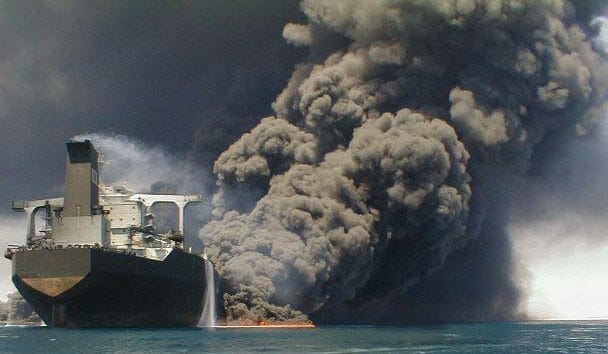
Source: http://timrileylaw.com/Limburg%20Oil%20Tanker%20Fire.jpg
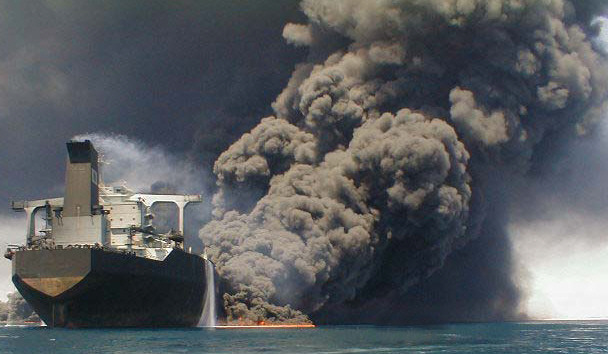
Caption: The M/V Limburg on fire after being hit by suicide small boats at port in Yemen
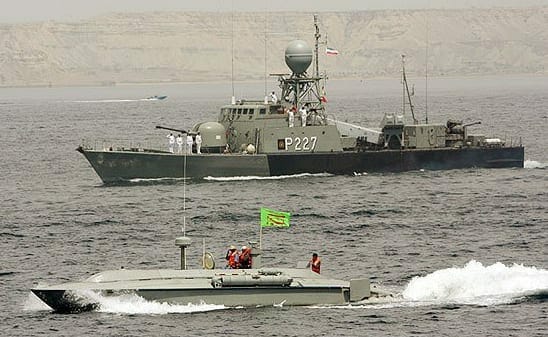
Source: http://media.farsnews.ir/Media/8501/ImageReports/8501170180/1_8501170180_L600.jpg

Caption: An example of an IRGC fast attack speedboat (nearside)
Iran & Small Boats
The Iranians used small speedboats extensively within the Gulf and the Strait throughout the 1980s Tanker War with Iraq, inflicting damage on vessels with rocket-propelled grenades (RPG) and machine guns.[xix] During the War, Iran often used the boats in shallower, coastal waters, where the boats could swiftly attack and then hide among the “multitude of islands, islets and coral reefs.”[xx] Iran also used small boats to lay mines with a small, crude onboard crane.[xxi]
Tactically, Iran commonly tried “mass swarming tactics” to attack using large numbers of small boats simultaneously. The largest of these attacks allegedly involved over forty individual boats.[xxii] These “mass swarm” attacks proved extremely vulnerable to U.S. air power during the Tanker War. This susceptibility may be one of the major factors causing the IRGC to retreat from a planned attack on Kuwaiti oil infrastructure in October 1987 in the face of a Saudi/U.S. show of air and sea strength.[xxiii]
Today, in addition to its conventional fleet of warships and larger patrol boats, the IRGC operates a vast fleet of small boats, estimated at more than 1000 boats in the 2004 Office of Naval Intelligence World Maritime Challenges report.[xxiv] Learning from past shortcomings of mass swarming tactics, Iran officially stated a new doctrine of “asymmetric” use of small boats. Instead of attacking all at once from the same direction, new Iranian strategy calls for dispersed swarming of 20-plus boats originating from a number of different directions.
Neither Iran’s mass swarming tactics nor its newer asymmetric procedures specifies using small boats in suicide attacks. However, because suicide tactics have proven relatively effective compared to small-arms attacks and because terrorists have demonstrated that effectiveness, it is not unreasonable to assume that Iran might use small boats in suicide attacks on tankers in a campaign to close the Strait of Hormuz.
[i] Matt Hillburn, “Asymmetric Strategy,” Seapower (December 2006), p. 16.
[ii] James Carafano, “Small Boats, Big Worries: Thwarting Terrorist Attacks from the Sea,” Heritage Foundation – Backgrounder (June 11, 2007), p. 2.
[iii] Boats are generally less than 65 feet in length. “Small” boats are not clearly defined, however, based on our research it seems those boats under 25-30 feet long would be considered “small.”
[iv] An example of a “patrol boat” (WPB “˜110 Island Class) is included at the following link. GlobalSecurity.org, WPB “˜110 Island Class. Online. Available: http://www.globalsecurity.org/military/systems/ship/wpb-110.htm. Accessed: October 11, 2007.
[v] James Carafano, “Small Boats, Big Worries: Thwarting Terrorist Attacks from the Sea,” Heritage Foundation – Backgrounder (June 11, 2007), p. 2.
[vi] Seymour Hersh, “Last Stand; Annals of National Security,” New Yorker (July 10, 2006).
[vii] Chris Fowler, “USS O’Kane Conducts Counter Small Boat Attack Exercises,” Navy Newsstand (through globalsecurity.org). Online. Available: http://www.globalsecurity.org/military/library/news/2006/10/mil-061002-nns03.htm. Accessed: October 2, 2007.
[viii] Nizar Hamdoon, “Iraq’s Washington Envoy Looks Back,” Defense & Foreign Affairs (September 1987), p. 56.
[ix] Brian A. Jackson, Peter Chalk, R. Kim Cragin, Bruce Newsome, John V. Parachini, William Rosenau, Erin M. Simpson, Melanie Sisson, Donald Temple, “Breaching the Fortress Wall: Understanding Terrorist Efforts to Overcome Defensive Technologies,” RAND Homeland Security, (2007).
[x] Brian A. Jackson, Peter Chalk, R. Kim Cragin, Bruce Newsome, John V. Parachini, William Rosenau, Erin M. Simpson, Melanie Sisson, Donald Temple, “Breaching the Fortress Wall: Understanding Terrorist Efforts to Overcome Defensive Technologies,” RAND Homeland Security, (2007).
[xi] “Tamil Tigers claim tanker attack,” BBC News Online (October 31, 2001). Online. Available: http://news.bbc.co.uk/1/hi/world/south_asia/1628218.stm. Accessed: October 9, 2007.
[xii] “Tamil Tigers claim tanker attack,” BBC News Online, (October 31, 2001). Online. Available: http://news.bbc.co.uk/1/hi/world/south_asia/1628218.stm. Accessed: October 9, 2007.
[xiii] Richard Beeston, “Tamil Tigers Sink Peace Hopes with Suicide Raid at Sea,” The Times, Overseas News (May 13, 2006), p. 44.
[xiv] Richard Beeston, “Tamil Tigers Sink Peace Hopes with Suicide Raid at Sea,” The Times, Overseas News (May 13, 2006), p. 44.
[xv] Michael Greenberg, Peter Chalk, Henry Willis, Ivan Khilka, and David Ortiz, Maritime Terrorism (Santa Monica, CA: RAND Corporation, 2006), p. 20.
[xvi] James Carafano, “Small Boats, Big Worries: Thwarting Terrorist Attacks from the Sea,” Heritage Foundation – Backgrounder (June 11, 2007), p. 2.
[xvii] International Union of Maritime Insurance Conference, “Limburg Terrorist Attack: The incident and the Insurance Settlement,” IUMI, Singapore, (September 15, 2004). Online. Available: http://adm-svv-shr-lnx.sc.previon.net/mediaserver/api/getMediadata.cfm?media_id=2569&mandator=fw40_mandator_0235. Accessed October 7, 2007.
[xviii] Michael Greenberg, Peter Chalk, Henry Willis, Ivan Khilka, David Ortiz, Maritime Terrorism (Santa Monica, CA: RAND Corporation, 2006), p. 21.
[xix] Francis Clines, “Attacks on ships in gulf continue; 9 reported hit,” New York Times (September 2, 1987).
[xx] Nadia El-Sayed El-Shazly, The Gulf Tanker War (New York, 1998), p. 320.
[xxi] Martin S. Navias and E.R. Hooten, Tanker Wars: The Assault on Merchant Shipping During the Iran-Iraq Crisis, 1980-1988 (New York: I.B. Taurus & Co Ltd, 1996), p. 143.
[xxii] Matt Hilburn, “Asymmetric Strategy,” Seapower(December 2006), p. 16.
[xxiii] Martin S. Navias and E.R. Hooten, Tanker Wars: The Assault on Merchant Shipping During the Iran-Iraq Crisis, 1980-1988 (New York: I.B. Taurus & Co Ltd, 1996). p. 153.
[xxiv] Matt Hilburn, “Asymmetric Strategy,” Seapower (December 2006), p. 16.