ISP Releases Survey on Public Attitudes on US Intelligence for 2020
The Chicago Council on Global Affairs recently published the results from the fourth round of an annual poll sponsored by the University of Texas at Austin’s Intelligence Studies Project (ISP) that seeks to shed light on Americans’ perceptions of our intelligence agencies. The survey was conducted and reported by ISP Director Steve Slick, Strauss Center Distinguished Scholar Joshua Busby, and Clements Center Undergraduate Fellow Archit Oswal.
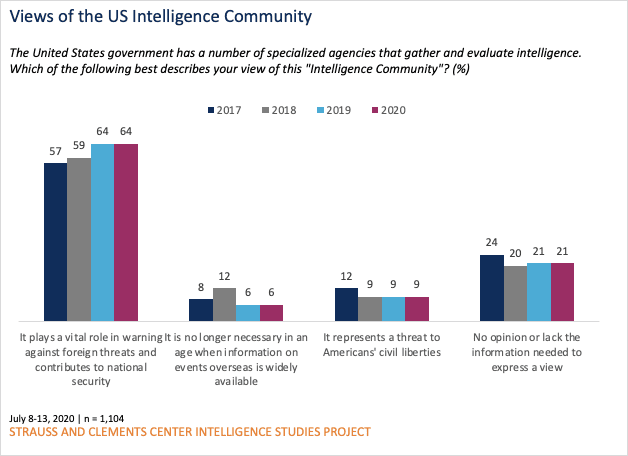
Our most recent survey reaffirmed Americans’ broad-based belief that our intelligence agencies are vital to protecting the nation and effective in accomplishing their core missions. This round of polling was the last conducted during Donald Trump’s presidency. The high levels of public support for the intelligence community (IC) recorded over the life of this project have proven stable and remarkably resilient to the persistent public criticism by the former president and his political allies.
The authors argue that close examination of the survey data could help inform a strategy aimed at further enhancing the IC’s democratic legitimacy through increased openness and renewed public engagement. Indeed, a majority (62%) of Americans in both 2019 and 2020 agreed that the IC could share more information about its activities with the American people without compromising its effectiveness. Support for greater openness tracked moderately with age (younger respondents were more likely to favor greater transparency) and more directly with partisan affiliation. Two-thirds of self-identified Democrats agreed or strongly agreed that more information could be shared but only half of Republican respondents thought that sharing more information with the public would be possible without the IC compromising its effectiveness.
Key Takeaways from the 2020 Survey:
- A strong majority of Americans (64%) believes that the IC plays a vital role in protecting the nation. Popular support for the intelligence agencies has proven consistent, bipartisan, and notably resilient over a four-year span marked by unprecedented hostility emanating from a US president. Younger Americans are less inclined than their elders to regard the IC as necessary.
- An overwhelming majority of Americans rate our intelligence agencies as capable in accomplishing their specialized missions with more than 8 in 10 rating the IC as effective or highly effective in preventing terrorist attacks (85%) and uncovering the plans of our adversaries (83%). However, barely half of Americans (52%) believe that US intelligence agencies are effective at safeguarding citizens’ privacy rights and civil liberties.
- While Americans are evenly split on the need to respect the privacy rights of foreigners to the same degree as US citizens, this overall result masked significant age and partisan differences. 73% of Millennials agreed that IC agencies should protect the personal information of foreigners, but only 29% of Baby Boomers held that view. Democrats generally agreed that the IC should be constrained in its handling of personal data on non-Americans while many fewer Republicans supported this policy.
- A majority of Americans (62%) agreed the IC could share more information with the US public without compromising its mission effectiveness. Black (31%), Hispanic (29%), female (29%) and Gen Z (36%) respondents were the most likely to admit they lacked the information needed to form an opinion on US intelligence.
- Americans remain uncertain about which government officials or institutions are responsible for overseeing our intelligence agencies. Partisan affiliation appears to color these responses. Republicans (23%) were more than twice as likely as Democrats (9%) to believe the president was responsible for ensuring US intelligence agencies “act within the law and in the country’s best interest” while Democrats (27%) were more inclined than Republicans (11%) to charge the Congress with intelligence oversight.
The data from Summer 2020, along with selected graphics, a summary of the survey history and methodology, as well as related policy analysis is available here.
More news from Strauss
2023-2024 Public Opinion on U.S. Intelligence
Strauss Center Distinguished Scholar Joshua Busby, Intelligence Studies Project Senior Fellow Stephen Slick, and Intelligence Studies Project Program Manager Kim Nyugen recently published their poll findings in Lawfare on public attitudes towards the U.S. Intelligence Community. Polling was sponsored by the University of Texas at Austin and was conducted between 2023 and 2024. Key takeaways from the polling illustrate that a...
ISP Tearline Team Reports on Russia’s Planned Naval Base Near Port Sudan
ISP’s Tearline student research team recently published an open-source report analyzing the impact of the May 2025 drone attack by the Sudanese Rapid Support Forces on infrastructure in the vicinity of Russia’s planned naval base in Sudan. The team assessed that Russia is unlikely to realize their plans for a naval base near Port Sudan in the next 6 to 12 months due to the...
Alexandra Sukalo Named Director of the Clements-Strauss Intelligence Studies Project
The Clements Center for National Security and the Strauss Center for International Security and Law at The University of Texas at Austin are pleased to announce the appointment of Dr. Alexandra Sukalo to lead the University’s Intelligence Studies Project (ISP). ISP was established in 2013 as a joint venture of the Clements and Strauss Centers out of a conviction that...