Strait of Hormuz – Submarines
A submarine is a specialized watercraft that operates underwater. Some submarines are capable of firing torpedoes, cruise missiles, or ballistic missiles. Furthermore they can be used to lay mines. Submarines have a number of operational tasks: denying the access to the ocean to hostile naval forces through anti-submarine and anti-surface warfare, detecting and destroying hostile submarines, detecting and destroying hostile surface ships, performing covert infiltration of hostile regions, listening for hostile activity, providing intelligence and undersea protection for aircraft carriers and their support vessels, and striking ground targets with missiles.[i]
Currently Iran only possesses Kilo Submarines, a type of diesel-electric submarine, although Iran is also rumored to have purchased some North Korean mini-subs and to have worked on some indigenous designs.
- Kilo Submarines
- Countermeasures
- Relevant Historical Uses of Submarines
- Iran & Submarines
RESOURCES
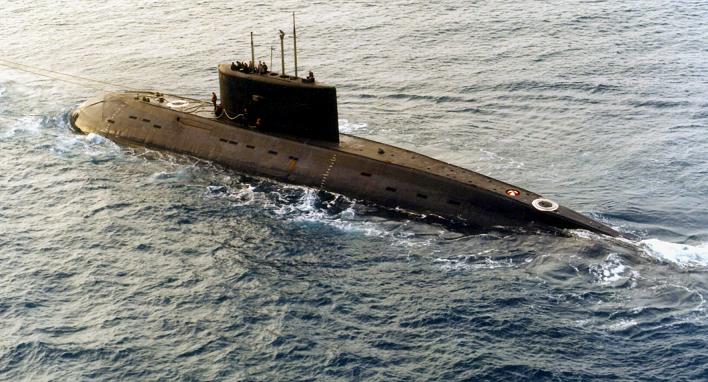
Source: http://www.defenselink.mil/photos/newsphoto.aspx?newsphotoid=529
Caption: Picture of a Russian-built, Kilo-class submarine, purchased by Iran in 1996
Kilo Submarines
Kilo submarines also face some difficult constraints on their ability to operate in the Persian Gulf. Fast currents make them difficult to control in some areas, notably near the Strait. Moreover, their minimum operational depth is about 150 feet, which limits their flexibility: the Strait and the Persian Gulf have a lot of water that is “deep” compared to the draft of even very large surface ships but that is “shallow” for a submarine.
The Kilo-class submarine is equipped with six 21-inch diameter torpedo tubes and can carry a total of 18 torpedoes (six in the tubes and 12 reloads in the torpedo room) of various types, including wake-homing torpedoes.[v] In lieu of torpedoes, the Kilo submarine can carry 24 mines or (possibly in the future) submarine-launched anti-ship cruise missiles (ASCMs). [vi]
Kilos use a combination of electrical and diesel power for propulsion – generally electrical power when submerged and diesel power when surfaced and for charging their batteries. Because the submarine must surface to re-charge, the charging time, speed while submerged, and the overall capacity of the batteries determine its submerged transit distance.[vii] This trade-off between snorkeling and submerged operation is referred to as the indiscretion ratio.[viii] This indiscretion ratio limits Iran’s capabilities to carry out its covert missions, but not too much, because travel distances in the Persian Gulf are relatively short.
Countermeasures
While submarines are extremely effective in naval warfare, they are not invincible. Submarine detection is the first element in countering an attack by a submarine. The different types of submarine detention mechanisms include Radio intercept, Radar, Sonar, and Magnetic Anomaly Detection.
Once the submarine has been detected, the second element is destroying the submarine. This can be done using gunfire, missiles, torpedoes, mines, depth charges and anti-submarine mortars. Although tankers do not carry countermeasures against submarines, U.S. Navy combatants deployed in the Persian Gulf do.
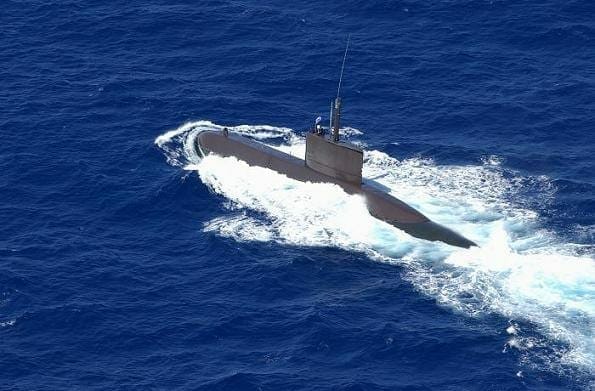
Source: www.acig.org/artman/uploads/bphoto08_001.jpg

Caption: A Mirage aircraft firing an Exocet missile
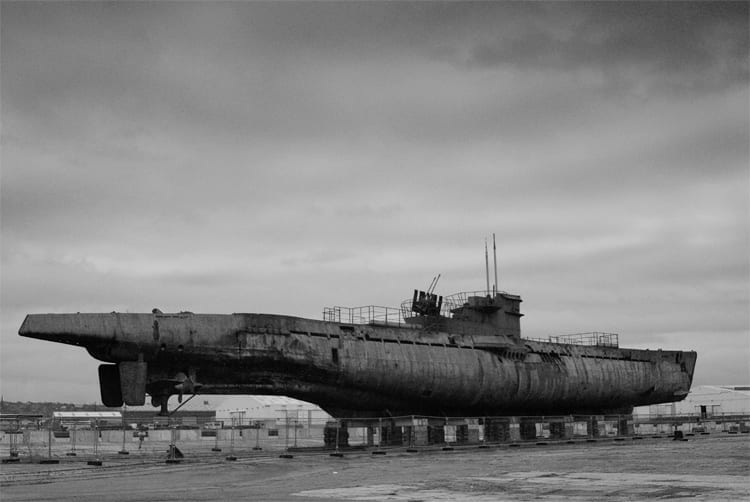
Source: http://en.wikipedia.org/wiki/Image:U534.jpg

Caption: A dry-docked German U-Boat from the WWII era
Relevant Historical Uses of Submarines
The historical background attests to the effectiveness and shortcoming of submarines in naval warfare. World War I, World II, and the Falklands War provide examples of the utility of diesel-electric submarines ” and of how they can be overcome.
However, the situation in the Strait of Hormuz differs from the past examples in one big respect: the geographical area in which Iran will be operating (the Persian Gulf) is much smaller than the area in which Argentina (South Atlantic Ocean), Germany (North Atlantic Ocean), and the United States (Pacific Ocean) were operating. The small area will make it difficult for submarines to go unnoticed.
Diesel Submarine Usage in World War I and World War II Expand
During World War I, German submarines wreaked havoc with Britain’s maritime trade, sinking hundreds of thousands of tons of cargo ships carrying goods vital to sustaining the island nation’s war effort (including foodstuffs and industrial goods needed for the home front). Submarines were also somewhat effective against warships, although fleet defenses generally kept the submarine threat at bay. In 1914, a single German submarine, the U-9, sank three British armored cruisers, revealing the submarines’ effectiveness in deep-sea (“blue water”) combat.[xi]
In World War II, the success of Germany’s U-boat campaign in the Atlantic against U.S. and Allied shipping ebbed and flowed. In the end, the submarines were overcome by a combination of changing Allied tactics, code-breaking, extension of the Allied air perimeter, technological advances (including better sonar, sonar buoys, the advent of radar), and better weapons (including more advanced depth charges, hedgehogs, ASW mortars, and air-dropped torpedoes) ” although perhaps the biggest contribution to ovewhelming the submarine threat came simply from the industrial capacity of the United States to produce more and more ships and to fill them with cargo.[xii] In the Pacific, on the other hand, the United States’ submarine campaign was instrumental in defeating the Japanese. The United States sank more ships through submarine warfare than the Japanese could build. [xiii]
Diesel Submarine Use in the Falklands War (1982) Expand
Argentina had a total of four World War II-era diesel submarines during their war with the UK over control of the Falkland Islands. Two Argentine submarines were tied up in port: one of the submarines, the Salta, had a depleted battery, and the Santiago del Estro had been disassembled for spare parts.[xiv] A third Argentine diesel submarine, the Santa Fe, was badly damaged and rendered inoperable after being attacked.
Despite the limits on the Argentine capability, British forces spent a great deal of time attempting to track the Argentine submarines, frustrated by the difficulty of conducting sonar operations in shallow water.[xv] In one incident, the fourth Argentine diesel submarine, the San Luis, was able to escape attack by “bottoming.” Even though the San Luis was located by a British frigate’s sonar, the frigate’s homing torpedoes were not able to find and destroy the submarines.[xvi]
Iran & Submarines
The depth of Strait of Hormuz (depth of 82 feet to 131 feet) is deep enough for ships, but is shallow for the submarines. The shallow waters and strong currents of the Strait both hamper and aid submarines ” the water provides noisy background conditions that help cover up the sound of a submarine, but the shallow waters make the submarine more likely to be visually identified from the air or surface of the water. The confined waters and strong currents of the Gulf make the Strait of Hormuz an extremely hazardous place for even experienced submariners. [xvii]
The Kilos that Iran owns need to be modernized in order to keep their aging military equipment from becoming irrelevant. Modernizing the Iranian kilos comes with a high price tag of $80-90 million per submarine.[xviii] The Kilos’ immediate threat is their ability to lay mines. Submerged Kilos offer the capability to covertly[xix] deploy 24 to 36 mines per sortie.[xx] However, Iran’s indigenously produced (moored or floating) mines[xxi] are not deployable by submarine.[xxii]
In the end, the two or three Iranian Kilo submarines would have a very short period of survivability when confronted by the United States’ anti-submarine warfare forces.[xxiii]
[i] British Royal Navy, Submarine FAQ. Online. Available: http://www.royalnavy.mod.uk/server/show/nav.2559 Accessed: April 23, 2008.
[ii] Naval-technology.com, SSK Kilo Class (Type 636) Attack Submarine, Russia. Online. Available: http://www.naval-technology.com/projects/kilo/index.html. Accessed: April 2, 2008.
[iii] Federation of American Scientists, Diesel-Electric Torpedo Submarine. Online. Available: http://www.fas.org/man/dod-101/sys/ship/row/rus/877.htm. Accessed: April 2, 2008.
[iv] Shirley A. Kan, Christopher Bolkcom, and Ronal O’Rourke, “China’s Foreign Conventional Arms Acquisitions: Background and Analysis,” Congressional Research Service Report for Congress, (October 10, 2000), p. 60.
[v] Shirley A. Kan, Christopher Bolkcom, and Ronal O’Rourke, “China’s Foreign Conventional Arms Acquisitions: Background and Analysis,” Congressional Research Service Report for Congress, (October 10, 2000), p. 60.
[vi]Shirley A. Kan, Christopher Bolkcom, and Ronal O’Rourke, “China’s Foreign Conventional Arms Acquisitions: Background and Analysis,” Congressional Research Service Report for Congress, (October 10, 2000), p. 60. Iran could retrofit its three Kilo Submarines with the capability of shooting Club-S missiles at a cost of $80-90 million per submarine.
[vii] Roy Burcher and Louis Rydill, Concepts in Submarine Design (Cambridge: Cambridge University Press, 1998), p. 126.
[viii] Roy Burcher and Louis Rydill, Concepts in Submarine Design (Cambridge: Cambridge University Press, 1998), p. 126.
[ix] Robert Jackson ed., Encyclopedia of Warships (San Diego: Thunder Bay Press, 2006), p. 361.
[x] The first diesel-powered submarine, the Aigrette, was built in 1904 by France. James L. George, History of Warships: From Ancient Times to the Twenty-First Century (Annapolis: Naval Institute Press, 1998), p. 158.
[xi] James L. George, History of Warships: From Ancient Times to the Twenty-First Century (Annapolis: Naval Institute Press, 1998), p. 160.
[xii] James L. George, History of Warships: From Ancient Times to the Twenty-First Century (Annapolis: Naval Institute Press, 1998), p. 166.
[xiii] G. H. Pearsali, The Effects of the World War II Submarine Campaigns of Germany and the United States- A Comparative Analysis (Newport: Naval War College, 1994).
[xiv] “The Lesson of San Luis,” International Defense Review, Vol. 30 No. 8, p. 36.
[xv] “Solutions to the Shallow-Water Challenge,” Jane’s Navy International, Vol. 101 No. 5, p. 10.
[xvi] Norman Friedman, Sea Power as Strategy: Navies and National Interest (Annapolis: Naval Institute Press, 2001), p. 264.
[xvii] David Miller, “Submarines in the Gulf,” Military Technology, No. 17 (1993), pp. 42-43.
[xviii] Major Dale R. Davis, “Iran’s Strategic Philosophy and Growing Sea-Denial Capabilities,” Marine Corps Gazette, No. 59 (July 1995), p. 22. Michael Eisenstadt, Iranian Military Power: Capabilities and Intentions (Washington DC, Washington Institute for Near East Policy, 1991), p. 120.
[xix] During the Iran-Iraq War, the mine-laying ship Iran “Ajr” was tracked, boarded, and sunk by U.S. naval forces in September 1987. See Anthony Cordesman, The Gulf and the West: Strategic Relations and Military Realities (Boulder, CO: Westview Press, 1988), pp. 390-391.
[xx] Major Dale R. Davis, “Iran’s Strategic Philosophy and Growing Sea-Denial Capabilities,” Marine Corps Gazette, No. 59 (July 1995), p. 22. Michael Eisenstadt, Iranian Military Power: Capabilities and Intentions (Washington DC, Washington Institute for Near East Policy, 1991), p. 120.
[xxi] However, Iran has reportedly received as many as 1800 Russian and Yugoslav mines with its first Kilo (See James C. Bussert, “Modernized Iranian Navy Poses New Gulf Dilemma,” Signal, No. 51 (October 1996), p. 37-38.) and, as of 1998, was seeking to purchase rocket-propelled EM52 mines from China (See James C. Bussert, “Modernized Iranian Navy Poses New Gulf Dilemma,” Signal, No. 51 (October 1996), p. 142); and James Bruce, “Choking the Strait: Iranian Naval Firepower and the Threat to Gulf Shipping,” Jane’s Intelligence Review, No. 8 (September 1996), p. 412).
[xxii] Michael Eisenstadt, Iranian Military Power: Capabilities and Intentions (Washington DC, Washington Institute for Near East Policy, 1991), p. 141.
[xxiii]David Miller, “Submarines in the Gulf,” Military Technology, No. 17 (1993), p. 22.